Showing posts with label Memes. Show all posts

Friday, July 31, 2015

Lessons in Education, Featuring Gary Larson: Part II

By EdTechManiac, Darin Anderson

In Part II of our comical series on education reform, we examine two different ideas of education in need of some reform. Oh, and ducks...there will be lots of ducks.


Like most of Gary Larson's The Far Side comics, this particular frame offers both a superficial humor as well as a deeper, more philosophical meaning. In this post, I will offer my thoughts on both levels of understanding as they relate to education reform - or altering behavior in any aspect of our lives.

The initial humor is found is the obvious fact that ducks fly, but for some reason or another, this particular brace (look it up) has not yet lifted its wings to the air, so to speak.


Here, Bugs Bunny offers up a cruel bit of irony, at least where Daffy Duck is concerned. In order to save himself from disaster, all the duck has to do is flap his wings, or take advantage of his natural abilities. But he doesn't.

So too, we laugh at the blatant irony of the lead duck looking up at his peers with the sudden epiphany that they too could fly. In educational terms, it is similar to a student (or teacher) who observes his own peers completing any certain action and then thinks, I can do that too. Before long they are simply soaring.

Sometimes all it takes to leverage change is for an interested party - often it is an impressionable child or teenager, but it can be an adult as well - to closely observe the behavior of others and then mimic it. While it is not always that simple in actuality, many behaviors (movements, actions, procedures) can be reproduced on the basis of mental images  - let's call them mind-made movies - alone.

In his book entitled The Inner Game of Tennis, tennis pro Timothy Gallwey speaks of the battle between Self 1, our mind and ego, and Self 2, the part inside of us all that knows what to do if not interrupted by the conscious brain.

Gallwey explains his theory in the context of a tennis lesson he once gave: 
"My next lesson that day was with a beginner named Paul who had never held a racket. I was determined to show him how to play using as few instructions as possible; I'd try to keep his mind uncluttered and see if it made a difference. So I started by telling Paul I was trying something new. I was going to skip entirely my usual explanations to beginning players about the proper grip, stroke and footwork for the basic forehand.
"Instead, I was going to hit ten forehands myself, and I wanted him to watch carefully, not thinking about what I was doing, but simply trying to grasp a visual image of the forehand. He was to repeat the image in his mind several times and then just let his body imitate. After I had hit ten forehands, Paul imagined himself doing the same. Then, as I put the racket into his hand, sliding it into the correct grip, he said to me, "I noticed that the first thing you did was to move your feet." I replied with a noncommittal grunt and asked him to let his body imitate the forehand as well as it could.
"He dropped the ball, took a perfect backswing, swung forward, racket level, and with natural fluidity ended the swing at shoulder height, perfect for his first attempt! But wait, his feet; they hadn't moved an inch from the perfect ready position he had assumed before taking his racket back. They were nailed to the court. I pointed to them, and Paul said, "Oh yeah, I forgot about them!" The one element of the stroke Paul had tried to remember was the one thing he didn't do! Everything else had been absorbed and reproduced without a word being uttered or an instruction being given!"
Most of us self-identify as being visual learners, and this anecdote fully supports that idea. Our students and teaching peers can and do learn so much by closely watching those around them. I imagine that these ducks will be joining their brethren in the sky in no time...as long as no one intercedes and tells them they cannot or should not be doing so. Or worse yet, over-instructs to the point of confusion and discontent between Self 1 and Self 2.

Gallwey put it this way:
"...it is the constant "thinking" activity of Self 1, the ego-mind, which causes interference with the natural doing processes of Self 2. Harmony between the two selves exists when the mind itself is quiet. Only when the mind is still is one's peak performance reached."
While I do not know if anyone told these ducks to walk south instead of fly, it appears that their minds were indeed getting in the way. The old adage, "Spread your wings and fly," is more truth than fiction, at least in a philosophical sense.

How many children enter Kindergarten having been told over and over to not do this or to stop doing that? And once they gain entrance to the school walls do they not still hear the same tone on a daily basis?

Ask a duck. He knows the answer.
If a child wants to experiment with something new, whether it is a new piece of technology or simply a new way of completing a task, is she honestly given the freedom to do so? Educators preach ingenuity and creativity, but how many of us are actually willing to not just lighten up on the reigns, but to take off the halter all together?

Furthermore, how willing are we as educators to model the same kind of behavior by integrating something new into our respective classrooms? Technology. Behavior Management. Student Engagement.

If you think of the flying V formation as a peer you respect and admire - and yourself as a ground-bound duck - does it seem silly to you to NOT try and reach for higher climes? Of course we would make an attempt.

The capacity to excel exists in all of us  - even as most of us will never become as talented as Serena Williams or Roger Federer are at tennis. We do not all have to be given teacher-of-the-year awards to be considered great. But like hitting 9 out of 10 balls in the court is amazing, so to is believing in the children we teach.

Wednesday, July 8, 2015

A Story of Assessment and Evidence: NBA Edition

Stop me if you've heard this one:

Two teachers walk into a school, and the principal asks them where their student data is.

___________________________________________________________________

Let's face it. As educators we live in an assessment-heavy, data-driven world governed by the results-indicator division of academic law enforcement (legislation). There is no way to escape without measuring our students with some form of data or another. However, while I understand the necessities of curating and monitoring students numerically, there are more ways to gather meaningful evidence than simply giving our kids "common" assessments and sharing spreadsheets with one another at staff meetings.

Let me put it to you this way, in the language of the National Basketball Association:

In 1984, the Chicago Bulls drafted Michael Jordan, who went on to become arguably the greatest player in the history of professional basketball. Jordan's 6 World Championships, 5 league MVP awards, 6 NBA Finals MVP awards, 3 All-Star Game MVP trophies, and 2 Olympic gold medals make him every bit the part of a high school valedictorian. In comparing His Airness to a student, Jordan's "academic" record would make him the model pupil who aced every test given him and graduated with high honors.

Now compare Jordan to two other former NBA players also selected in the 1984 NBA Draft - one named Sam Bowie and the other Landcaster Gordon. Bowie, a 7-1 skyscraper, had a stellar basketball career at the University of Kentucky, while Gordon, a 6-3 guard, starred at Louisville. However, neither of them has the same NBA portfolio as does Michael Jordan (see below). Given that their college "evidence" was relatively similar (see below) we would assume, given educational analysis, that all three would be relatively successful in the professional ranks.

College Stats - Source: Basketball-Reference.com
NBA Stats - Source: Basketball-Reference.com
Here is the kicker. Bowie was chosen second overall by the Portland Trailblazers, and Gordon went to the Los Angeles Clippers as the eighth overall selection. Jordan - the best player the world has ever seen - was picked third. Bowie has become the punchline of several Jordan jokes while no one really has ever heard of Landcaster Gordon. (And no, it is not this guy to the right.)

The data, in this case, did not tell the entire story.

Granted, selecting players in the NBA draft is no easy science, anymore than that of predicting the academic achievement of students - or what they might accomplish as the venture into the world of employment.

Gordon, #4, never fulfilled
his NBA potential
In the case of Michael Jordan, he was pegged (based largely on data) as a future superstar and lived up to the hype. Bowie, who had impressive numbers as well, was a marginal pro with a lackluster career. Gordon? Well, he was the kid with data-proven "potential" who never quite measured up.

Despite all of the assessment data we gather on our kids, there are obviously several untold stories that combine to make each and every student who they are - individually.

I argue that data - be it from common assessments, standardized testing, or any number of other formats - only tells a part of the story. If college success unilaterally foretold professional achievement, then life would be so much easier for the highly-paid executives, coaches, and players in the NBA. However, like education, success on one assessment (college play) does not mean "proficiency" on another (professional performance).

To help all students complete their own stories, educators need to provide opportunities for them to give performances in the realm of any given content or concept, but on stages of their choosing. Michael Jordan was an amazing basketball player and proved as much against the best the work had to offer. Bowie was also a stellar player, up until he faced the cream of the crop. NBA stardom was just not in his cards. (To be fair, Bowie suffered from foot injuries that were beyond his control and those kept him from reaching his true potential; ultimately, he was never anything more than a serviceable player.)

The point is, each and every college player with aspirations of playing in the NBA is given ample opportunities to show his talents against some of the best prospects in the world. The NBA has a summer league devoted to giving young, unestablished players chances to impress coaches and front office personnel. There is also a developmental league (the NBDL) for not-yet-ready players that serves as the minor league system for major franchises.

Manute Bol was 7-6!
Do we do the same for our kids? If they struggle in one aspect of learning do we write them off as Landcaster Gordons who will never cut it in "real world" environments? Are they cast off from consideration because they do not show the proper "academic" prowess that we'd like to see? Honestly, if Sam Bowie was only 6-7 instead of 7-1, would anyone have paid him any attention? And thus do we intentionally leave kids off "the team" because of what they don't possess?

Give Michael Jordan a basketball and he would absolutely amaze us with his abilities on the court. Put a skateboard under the feet of Tony Hawk and he'd leave us in awe. Place Missy Franklin in a pool and she'd leave us shaking our head in disbelief. Hand a mic to Aretha Franklin and be prepared for an all-out show. Conversely, if we gave them all a standardized test, would we be equally as satisfied?

Aside from the obvious and mandated assessment that permeates our academic landscape, look to find other ways for kids to truly show what they know. Here are just a few tips:

  • Student-made videos: These creations can let student personality and ability shine through. Upload to YouTube or share with social media.
  • Video game creations: Programs like Minecraft have become viable avenues to let students create and explore ideas. Another example of letting them use the tools they already have.
  • Cartoons and animation: From the advanced (Scratch) to the intermediate (PowToon) to the basic (Google Slides), students can tell a story in so many different ways. Let them do it in their own way.
  • 3D modeling: Tinkercad is just one way kids can create any 3D image imaginable. It's great for learning math and science especially, but works with any content. Integrates with 3D printers perfectly.
  • Interactive whiteboards: Apps like Explain Everything allow kids to talk their way through concepts and knowledge without the nervousness of speaking in front of the class.
  • Music, poetry, and other forms of art: These modes of expression are so much of our students' world right now. Let our kids be artistic and creative and fresh. Even the most timid personalities will bloom.
  • App creation: There are several free programs that provide app creation services - everything from basic features to advanced functions.
  • Ask the students: It might surprise us adults to know that our kids do possess actual talents and abilities that do not fit into the traditional mold of academia. Let that archaic philosophy go. After all, we are preparing them for THEIR world, not OURS. Sure, we know how to excel in today's world, but don't we go about our lives differently than our parents and grandparents did?
  • Genius Hour: Set aside a few hours a month for kids to explore and do what they want. The results from GHs are astounding.
  • It is no excuse that WE don't know all about these options. What's more, it is unacceptable if our students do not know about them. We are doing our kids a disservice - academic malpractice even - if we do not expose them to these options and let them explore and create.
Think about this:

What will be the basketball...the skateboard...the microphone...the computer program...that turns your kids into Michael, Tony, Aretha, or Mark.

What will they do to complete their story?

Will we let them?

Follow us on Twitter for more EdTech integration tips and ideas. Also follow Maniac Darin Anderson.

Saturday, May 23, 2015

A Picture IS Worth 1000 Words: Making the Most of Memes and Gifs

Teachers often lament about how short their kids' attention spans are.

While I certainly agree that students of all ages should work to pay more and better attention to adults, the fact of the matter is this:

We just aren't feeding them what they want to eat, if you catch my drift.

Most teachers today, at least those of us who've been at it for a decade or so, grew up in a world of relative isolation.

My hometown of Mackay, Idaho (population 541) for example, received the daily newspaper two days after it was printed. Unlike those folks in more metropolitan areas, I had to wait until Tuesday after school to find out the NFL scores from the previous Sunday. It was a place where time stood still.

But now, with the Internet making the world a much smaller place, our students no matter where they grow up, have access to more information than we could ever consume in 100 lifetimes. And this info comes at them in short and enticing bursts. Unless something blows up or makes a funny noise, our kiddos lose interest after mere seconds. 

Simply stated, kids these days DO pay attention, just not to boring and outdated lessons and assignments they are too often subjected to. What "worked just fine for us," is no longer enough reason to keep students engaged.

What's more, the material and content they do pay attention to is a product of our instant-oatmeal-microwave-popcorn society. And it comes in 6-second chunks known as Vines.

To be clear, in no way am I suggesting that educators abandon traditional teaching styles in favor of quick flashes of lighting in the front of the room. What I am offering is some advice:

Why fight it? Take advantage of their popularity.

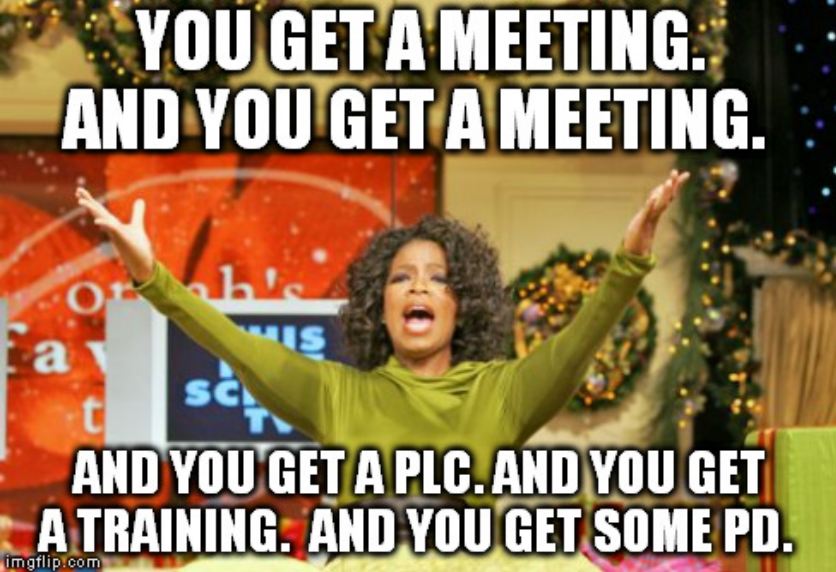
Short and pointed comments in the form of Vines, MEMEs and GIFs are a widely accepted form of communication and one that many teachers have gravitated towards to engage students and enrich their learning. Used as class warm-ups or exit tickets, or as a summary and reaction medium, memes and gifs allows students to express a certain point-of-view or opinion in just a few words.

Although some memes are as shallow as a sit-com quarterback, a picture with just a few words can show a depth of understanding akin to a short poem. Just the right facial expression combined with an exact phrase can tell an entire story.

Without further adieu, here are few of the Ed Tech Maniacs favorite educational (let's use that term loosely, shall we?) memes and gifs. Sit back and enjoy.

Feel free to Tweet us your own favorites so the eduworld can take part in the fun together.


Teachers at lunchtime