In regards to effective lesson delivery, there is much to be said about strategies, structures, and seating arrangements - and such - being the road to quality.
The notion - a partially correct one - is that better instruction will yield better student results. While it is true - remember, I say it is partially correct - that being a better deliverer of content does help students grasp that content, I firmly believe that it is just the entrance to a vast corridor of potential knowledge, skills, and opportunities - for our students.
Let me offer up two examples to help illustrate my point:
1) My family physician is very good at analyzing my vitals and symptoms and then prescribing a medicine for me that will have positive effect. I correctly assume that he not only memorized medications and body parts & functions and flaring symptoms but that he also had extensive practice in applying that knowledge to my medical needs.
2) Chris EveryStudent sits in a classroom day after day and is exposed to the most engaging, vivid, and innovative instructional strategies available to mortal mankind. He watches videos and participates in Kahoot presentations and straps on his Google Cardboard everyday. Through VR devices, he is exposed to life outside of his city and into unknown parts of the world full of mystery and intrigue.
Then, at the end of it all, he is asked to write a five paragraph essay that details his experiences and learning. (I grant that this is a blanket statement, but, for the sake of my argument, work with me here.)
So my question is this: While innovative instruction is a vital part of every teacher's daily life, why are they all so quick to assess students in an environment largely devoid of STUDENT INNOVATION?
Few teachers would ever design instruction that is akin to a five paragraph essay. So why are we asking our students to "show what they know" is such ways?
Something to think about...
Follow me on Twitter and Instagram at @coachdarin22

Showing posts with label Education Reform. Show all posts
Showing posts with label Education Reform. Show all posts
Friday, June 17, 2016

Friday, May 13, 2016
Seeing the Forest AND the Trees: Student Exploration Time

By Darin Anderson
Picture this: You arrive for your first painting lesson from a renowned local artist. Before you lay all the materials you need to begin creating your first masterpiece.
As you settle in with your surroundings, in walks the artist, who begins visiting with each participant about the beauties of art and painting.
You simply cannot wait to get started.
Monsieur Paintbrush walks to the front of the room and begins speaking to the group about the endless possibilities of paints and palettes and prisms of color. He continues into very interesting dialogue about purpose and passion, and you become even more excited to fill your empty canvas with wonder.
However, as the minutes pass by, you notice the instruction, while incredibly valuable and inspiring, has left you no time to do what you came for.
As the artist bids you a find adieu, you leave your still blank canvas and pristinely clean brushes behind, hoping for a chance - next time - to work wonders with them.
_______________________________________________
Would you stand for such circumstances? Regardless of whether or not you paid a fee for the class, I'm certain you would be disappointed with the outcome. Why, you never even got to open up the paints!
Imagine the thousands of students who walk in and out of thousands of classrooms each school day with the same emotions - "Sounds cool, but I never even got a chance to try it out!"
Now, imagine yet another situation - similar and just as frustrating to our students:
Monsieur Paintbrush walks to the front of the room and instructs you to follow his lead in painting a red flower. He takes you step by step through the process, even stopping the class to ensure that each participant neither speeds ahead or lags behind. "We all must build the red flower as I do," he says.
Since you are a decent painter who has done his or her share of flowers, bushes, and trees, you begin to become antsy and annoyed at the teacher for not letting you "do your own thing" and paint what you want. But in the interest of staying with the group you decide to just remain silent and paint your red flower.
_____________________________________________________
While I understand the need for direct instruction and scaffolding in classrooms, I believe that we often go overboard with controlling the scenario in the interest of classroom management and, honestly, making our own lives as teachers easier.
However, many of our students leave classrooms each day without having had the opportunities to explore and design and create and tinker with (insert content/skills here).
Think of the tools we have in our classrooms that are metaphorically represented by the canvas, brushes, and paints in our story:
Computers and laptops
iPads and other tablets
Video cameras
Student Smartphones
3D Printers (perhaps)
CNC Machines (perhaps)
Not to mention these:
Glue
Scissors
Cardboard
Paper
String
Plutonium (according to Dr. Emmett Brown, it should be readily available these days)
3D Printers (perhaps)
CNC Machines (perhaps)
Not to mention these:
Glue
Scissors
Cardboard
Paper
String
Plutonium (according to Dr. Emmett Brown, it should be readily available these days)

For example:
+ Google Hangouts or Skype allows staff and students access to content area experts all over the world.
+ 3D programs such as Tinkercad and Thingiverse make design and creation easily accessible for users.
+ Video and audio creation programs allow students to express themselves as never before.
+ 24/7 discussion and collaboration are a snap with Google Drive and a wide variety of social media outlets.
But here I am preaching to the choir. Or am I?
Please take to heart the memes inserted in this post. Ensure that on a daily basis you are having your students explore, create, design, and tinker with content, skills, and - most importantly - their own thoughts and ideas.
Our world - and their - will be the better for it!
Monday, April 4, 2016
Are After-School Programs Doing the Jobs that Schools Won't?
Perhaps you have experienced this story...
Your kid comes home from school, joyously speaking of a wonderfully new activity that will allow her to explore and create and laugh and have fun - all while learning about science and math and engineering and all of the other good stuff that happens in a child's life.
Excited for her new-found interest in academics, you ask her when this school project will begin.
 She opens her backpack and produces a large stack of papers, including math worksheets and artistic renderings of beasts and animals of every unimaginable kind. After rifling through the sheets for a few moments, she pulls out a purple flier and excitedly thrusts it out for you to see.
You look at it and your heart begins to sink. Instead of her school - the place in which she spends upwards of 8 hours a day - taking on this new and exciting and engaging project, you find that the United Association of Motherly Knights of Cincinnati are asking you to pony up a $75 "one-time" fee to have your precious daughter spend two nights a week at the local kids' club making, designing, and creating all kinds of science-y and math-y and engineering-y things.
If this is your story, sadly, you are not alone.
Across the country, our students are being relegated to national standardized testing, state-mandated assessments, and a wide variety and voluminous sets of school and classroom work... none of which I have a real problem with (but that is a different story for a different post).
What I am speaking more about is the manner in which many of our school approach the teaching and learning of academic concepts.
While the phrase "death by worksheet" is not the stuff of student lamentations in all schools in our country, there is a fair amount of academic institutions unwilling to make the break away from an antiquated system and move forward into engaging, high interest, and student-driven educational models such as PBL, inquiry-driven instruction, and makerspaces - to name just a few.
In the mean time, after-school programs offered by many local clubs and organizations have stepped in to fill the void of fun and excitement towards learning left by the monotony of funeral rows of desks in classrooms with lots of potential otherwise.
What's worse, many of these programs are funded and facilitated by the school districts themselves.
In effect, they are telling their constituents, "While we are mostly unwilling to provide students with quality and engaging classroom instruction during the day - our schedule and testing demands simply won't allow it - we are more than happy to offer an after-school program designed to provide your students (well, some students, as we are limited by funding to only 20 kids) with activities specially designed to expose them to STEM & STEAM concepts, all in a fun, yet structured environment."
My beef boils down to this:
If innovative after-school programs (and let's not forget summer school session designed to try something "new and different" for our struggling students) are yielding good results with high praise from kids, parents, and staff, why aren't schools clambering to the front of the line to get on board this train?
To be fair, I am not condemning education in general. While the minority may neglect their duties and responsibilities, most teachers and staff are putting forth a great and noble effort towards the students in their charge.
I am simply saying that we can all do better with the time and resources we have. If it is training we lack, there are no small numbers of "experts" willing to lend time and information. If it is initiative we are without, there are those out there who can lead and inspire us, whether in person or via social media and the like. (When WAS your last Twitter EdChat??) If it is resources we need, there are many who have traveled this path before who are willing to either shine the way or return and walk side-by-side with us.
It is not easy and we will face criticism from those who do not understand, but the majority will see the change for what it is. We talk often about doing what is best for kids. Here is YOUR chance. Get started today.
To quote a very intelligent and inspired leader, T.S. Monson, "Let us always choose the harder right rather than the easier wrong."
Your kid comes home from school, joyously speaking of a wonderfully new activity that will allow her to explore and create and laugh and have fun - all while learning about science and math and engineering and all of the other good stuff that happens in a child's life.
Excited for her new-found interest in academics, you ask her when this school project will begin.

You look at it and your heart begins to sink. Instead of her school - the place in which she spends upwards of 8 hours a day - taking on this new and exciting and engaging project, you find that the United Association of Motherly Knights of Cincinnati are asking you to pony up a $75 "one-time" fee to have your precious daughter spend two nights a week at the local kids' club making, designing, and creating all kinds of science-y and math-y and engineering-y things.
If this is your story, sadly, you are not alone.
Across the country, our students are being relegated to national standardized testing, state-mandated assessments, and a wide variety and voluminous sets of school and classroom work... none of which I have a real problem with (but that is a different story for a different post).
What I am speaking more about is the manner in which many of our school approach the teaching and learning of academic concepts.
While the phrase "death by worksheet" is not the stuff of student lamentations in all schools in our country, there is a fair amount of academic institutions unwilling to make the break away from an antiquated system and move forward into engaging, high interest, and student-driven educational models such as PBL, inquiry-driven instruction, and makerspaces - to name just a few.
In the mean time, after-school programs offered by many local clubs and organizations have stepped in to fill the void of fun and excitement towards learning left by the monotony of funeral rows of desks in classrooms with lots of potential otherwise.
What's worse, many of these programs are funded and facilitated by the school districts themselves.
 |
| Kennedy Space Center Education Foundation |
My beef boils down to this:
If innovative after-school programs (and let's not forget summer school session designed to try something "new and different" for our struggling students) are yielding good results with high praise from kids, parents, and staff, why aren't schools clambering to the front of the line to get on board this train?
To be fair, I am not condemning education in general. While the minority may neglect their duties and responsibilities, most teachers and staff are putting forth a great and noble effort towards the students in their charge.
I am simply saying that we can all do better with the time and resources we have. If it is training we lack, there are no small numbers of "experts" willing to lend time and information. If it is initiative we are without, there are those out there who can lead and inspire us, whether in person or via social media and the like. (When WAS your last Twitter EdChat??) If it is resources we need, there are many who have traveled this path before who are willing to either shine the way or return and walk side-by-side with us.
It is not easy and we will face criticism from those who do not understand, but the majority will see the change for what it is. We talk often about doing what is best for kids. Here is YOUR chance. Get started today.
To quote a very intelligent and inspired leader, T.S. Monson, "Let us always choose the harder right rather than the easier wrong."
Friday, January 29, 2016
Maker Education and the Common Core: Closer Than You Might Think
With Common Core State Standards being the driving force in education in The United States over the past several years, much attention has been paid to the subject of teaching and assessing our students based upon CCSS.
Due directly to both Federal and state mandates, our nation's education system has been bombarded with resources, curriculums, and programs designed to better teach Common Core and prepare our students for a new battery of standardized testing "options" designed to measure growth towards nationwide proficiency.
The added stress (to an already taxing field of work) has resulted in teachers and students alike growing tired and more disillusioned to the concepts of school, education, and learning - especially considering the following:
At the same time, educators have seen major moves towards gamification in the classroom, project or passion-based learning, STEM and STEAM Maker education, computer coding and many, many other non-traditional approaches to teaching and learning.
The desire to engage students in educational material, creativity, and collaboration (among other learning facets) seems, in some circles anyway, to overshadow the mandates of state and federal monitoring of student achievement.
The cry?
"While students are having fun making rockets and visiting zoos and playing Minecraft," critics claim, "they are not learning anything. And the test scores prove it. Our time, and the students' time, is better spent on covering meaningful content and prepping them for measurable assessments. We have the Common Core and we need to focus on student achievement and progress towards meeting those standards. Etc. Etc."
Stop me if you've heard that argument before.
For a dissenting (in a good way) voice I give you Sylvia Martinez and her stance on CCSS and the "Deeper" Learning:
If we are to teach/students to learn the necessary standards to the necessary depths, I contend that more must be done than simply offering up a common assessment every now and then or administering a bevy of benchmark exams at semester's end.
What follows is a short but poignant snippet of a recent Twitter chat, from our friends in Montana and #MTedchat
The question was this:
As a result, many teachers have burned bridges on building bridges, and fill their time instead on bubble sheets and #2 pencils.
However, here is some good news. As it turns out, there is a fairly logical way to bridge the gap between accountability towards Common Core (plus other standards) and "non-traditional" educational ventures.
The connection is best illustrated by using an example of a stalwart activity that has been popular amongst teachers and summer camp counselors across the world - The Tennis Ball Tower Challenge.
Often used as a teambuilder or icebreaker, the Tower Challenge may give surface appeal as a fun yet shallow activity. However, with some careful implementation, it can indeed unfold into a full blown, Common Core, #DeeperLearning, Maker Education crowd pleaser.
Take a look at this link for a spreadsheet that shows the correlation between steps of the Engineering Design Process (used for the tower building protocol) and Common Core ELA Standards. (Similar outcomes are possible, of course, with Math and Science Standards as well.)
The ultimate outcome of any lesson, activity, or project that teachers have students complete must be related to student achievement and academic and/or personal growth. Maker Education teaches and hones success skills.
Beyond simply having fun with school projects, our students deserve so much more. Maker Education - connected purposefully to Common Core Standards - is just what the doctor ordered.
Happy making, everyone!
Follow me on Twitter for more EdTech, MakerEd, and EdReform dialogue.
Due directly to both Federal and state mandates, our nation's education system has been bombarded with resources, curriculums, and programs designed to better teach Common Core and prepare our students for a new battery of standardized testing "options" designed to measure growth towards nationwide proficiency.
The added stress (to an already taxing field of work) has resulted in teachers and students alike growing tired and more disillusioned to the concepts of school, education, and learning - especially considering the following:
- In 2015, an estimated $950 billion of Federal, state, and local money was spent on education in the United States (according to usgovernmentspending.com). That number is expected to exceed $1 trillion by 2017.
- On average, US students are required to take 112 standardized assessments throughout their K-12 years, ranging from nearly 5 hours of testing per year for Kindergarteners to over 25 hours for our nation's 8th graders (see article about Council of Great City Schools study here).
- Despite large sums of money being appropriated to schools - and an emphasis on assessments to measure growth and school/teacher effectiveness - longitudinal test scores have remained largely flat (see Politifact Virginia article here).
At the same time, educators have seen major moves towards gamification in the classroom, project or passion-based learning, STEM and STEAM Maker education, computer coding and many, many other non-traditional approaches to teaching and learning.
The desire to engage students in educational material, creativity, and collaboration (among other learning facets) seems, in some circles anyway, to overshadow the mandates of state and federal monitoring of student achievement.
The cry?
"While students are having fun making rockets and visiting zoos and playing Minecraft," critics claim, "they are not learning anything. And the test scores prove it. Our time, and the students' time, is better spent on covering meaningful content and prepping them for measurable assessments. We have the Common Core and we need to focus on student achievement and progress towards meeting those standards. Etc. Etc."
Stop me if you've heard that argument before.
_______________________________________________
"I get asked a lot about how making and tinkering can be integrated into classes in light of the Common Core. I think there are good answers to this, but it involves seeing the Common Core as something more than it is being portrayed in the media and in schools.
"Simply, there are three parts to the Common Core – the overarching goals, the standards, and the assessments. I’m not going to go into great detail about each of these, but here is what I see happening in a lot of schools in each of these areas.
"Assessment – Tremendous effort is being put into getting students ready to take the assessments and preparing the technology infrastructure to administer the tests.
"Standards – New standards are driving changes to curriculum, but mostly in a rearrangement or rebranding of existing curriculum and classes.
"Overarching goals – Very little is being done to address the goals of changing how and what we teach students by making it more relevant, more experiential, and requiring deeper dives instead of “covering” too many topics.
"This is the problem I’m seeing – that assessment is the tail wagging the dog and taking the focus (not to mention money and time) away from changing classrooms for the better. So when we talk about how “making” can align with Common Core, it requires schools and districts to refocus on those overarching goals, and away from how many computers you need to run the tests. Unfortunately this is a conversation that is not taking place in many educational organizations."In short, Martinez is claiming that school systems are so entrenched in testing their kids that they forget to educate them. But again, stop me if you've heard this one.
If we are to teach/students to learn the necessary standards to the necessary depths, I contend that more must be done than simply offering up a common assessment every now and then or administering a bevy of benchmark exams at semester's end.
What follows is a short but poignant snippet of a recent Twitter chat, from our friends in Montana and #MTedchat
The question was this:
Q4: What higher-order thinking skills will students need to use to move beyond basic understanding of content text? #MTedchat
— Crista Anderson (@cristama) January 20, 2016
To help further Martinez's stance on teaching beyond the exact wording of the standards, this was my response:
Look at all the verbs in standards. THAT is what kids need to be able to do. #mtedchat #Imnotastalker https://t.co/F0ZZJSazYr
— Darin Anderson (@coachdarin22) January 20, 2016
Here are a few responses Tweeted out during the discussion:
#mtedchat A4 - Ss need curiosity! Are we stimulating that through inquiry?
— Marla Unruh (@bookwormmarla) January 20, 2016
@coachdarin22 I was once told that the standards are the floor, not the ceiling #mtedchat
— Bethany Gochnour (@GochnourBethany) January 20, 2016
In order to reach that ceiling, there is much construction we must do on the open floor space below.
@GochnourBethany @coachdarin22 A great opportunity with #PBL #STEM #makered #deeperlearning to build on that floor. #mtedchat
— Colet Bartow (@cbartow) January 20, 2016
While few educators disagree with the notion of Project-Based Learning, STEM, Maker Ed and the like, their implementation has been much more difficult to bring to pass - mainly because of the over-emphasis on rote testing at local, state and Federal levels. The message has been, "If your pet projects do not address the standards, you will have to give them up."As a result, many teachers have burned bridges on building bridges, and fill their time instead on bubble sheets and #2 pencils.
However, here is some good news. As it turns out, there is a fairly logical way to bridge the gap between accountability towards Common Core (plus other standards) and "non-traditional" educational ventures.
The connection is best illustrated by using an example of a stalwart activity that has been popular amongst teachers and summer camp counselors across the world - The Tennis Ball Tower Challenge.
Often used as a teambuilder or icebreaker, the Tower Challenge may give surface appeal as a fun yet shallow activity. However, with some careful implementation, it can indeed unfold into a full blown, Common Core, #DeeperLearning, Maker Education crowd pleaser.
 |
| Follow the link to the right for access to a Maker/CCSS example project. |
Take a look at this link for a spreadsheet that shows the correlation between steps of the Engineering Design Process (used for the tower building protocol) and Common Core ELA Standards. (Similar outcomes are possible, of course, with Math and Science Standards as well.)
The ultimate outcome of any lesson, activity, or project that teachers have students complete must be related to student achievement and academic and/or personal growth. Maker Education teaches and hones success skills.
Beyond simply having fun with school projects, our students deserve so much more. Maker Education - connected purposefully to Common Core Standards - is just what the doctor ordered.
Happy making, everyone!
Follow me on Twitter for more EdTech, MakerEd, and EdReform dialogue.
Tuesday, September 22, 2015
Lessons in Education Featuring Gary Larson: Part VIII
By Ed Tech Maniac, Darin Anderson

On the surface, this particular comic seems to be making fun of the perceived ineptness of this man to carry out a meaningful life. To be sure, what kind of buffoon finds it necessary to physically label each and every person, place, or thing on his property??
We waste no time in taking shots at this man, but are we really being fair to him?
For example, how many students do we come across each day that are in similar stations in life? Of course, the Chemistry teacher knows his periodic table from top to bottom and the Social Studies teacher can recite the Civil War from beginning to end without breaking a sweat. The Computer Tech instructor can code with the best of them while the Geometry teacher has a ruler on speed dial.
But do our kids show up with the same knowledge? Of course not!
It thus becomes imperative to have high expectations of learning with an understanding that we will have to lay things out very explicitly to most of our students, no matter what the content might be. "I taught it and they should have learned it," attitudes and assumptions are just not good enough.
The counter to the above statement is that the "real world" does not wait for us to learn before it asks us to perform. "I'm just trying to prepare them for when they get a job," they say, as they refuse to explicitly teach students skills and content.
While it is vital that our future workforce can problem solve and think independently, the fact remains that 14-year-old kids are not gainfully employed...and for good reason. They are not ready. They need to be taught explicitly the skills necessary to function in the world.
(The other counter? "They should get those skills at home. My job is to teach _________ ."
If the statement above were true, then why would kids need to go to school at all?
Truth is, a K-12 education is a necessary part of a child's development. It fills gaps, provides opportunities for growth and enrichment, and gives them environments to excel in their own areas of interest. Or it SHOULD, at least.
So instead of harping on those students (and co-workers) who may not have it all together, let's be patient and commence to spelling things out literally. It makes learning better for all of us!
Do we #teach this way? Should we teach this way?#EdChat #EdReform #Education pic.twitter.com/cX4Q0WW7Ib
— Darin Anderson (@coachdarin22) September 22, 2015
Monday, September 21, 2015
Earbuds Overload: Making the Most of Societal Escapes
By Ed Tech Maniac, Darin Anderson
If you work at or near a school (or airport or mall or anywhere else), you perhaps have noticed a disturbing trend amongst the youth - and many adults - of the world today.

I'm not talking about the styles of clothing, hair, and makeup that would make our grandmothers simultaneously shudder in fear and weep for the future. No, what I am referring to is the popular practice of earbuds being used as a recidivist devices.
From my observations in schools specifically, I have seen phone files firmly inserted as a divide between teacher & student and even student & student. While there is an appropriate time and place for music streamed through Beats by Dre, the idea of students retreating into themselves will not yield positive results in the long run.
The science behind the addiction to music provides insight into why helping students break away from earbuds will be both imperative to their wellbeing as well as an entirely difficult process.
Consider this generic scenario: A student leaves her house at 7:15am to board a bus that takes her to a place she does not necessarily want to go. Immediately she pops in her earphones and traces a path of social removal into a world that she both understands and enjoys. The music speaks to her and she lives her life accordingly even as she is surrounded by friends, peers, and copious amounts of school work that she may or may not find irrelevant.
Her teacher either allows her to be half-in during instruction (as is evidenced by the one ear-bud placed in her ear) or he has given up trying to get her involved in daily activities.
Knowing that the human brain, the frontal cortex in particular, cannot process more than one stimuli at a time, it is nearly impossible for hum-drum instruction or even interaction with peers to consistently win out over her undying interest in Fallout Boy or Major Lazer.
The concerns among teachers, of course, are the disengaged student and competing against what causes students to retreat. In years past, the devices were sufficiently large enough (think 80s style boomboxes) to not be practical, while the concept of connectivity was not even an issue. But now, in our connected society, educators must balance the use and the banishment of Personal Isolation Devices, or PIDs.
But now that the problem has been laid out, here are a few suggestions for either lessening the desire to sink into the world of earbuds or to temporarily abolish it:
When #1 is present, the need for music (or Instagram, etc.) subsides. When #2 is present the need for extraneous stimulus subsides. When neither is present, humans search for them both in other places, and often music becomes a simple stop-gap escape mechanism.
If you work at or near a school (or airport or mall or anywhere else), you perhaps have noticed a disturbing trend amongst the youth - and many adults - of the world today.
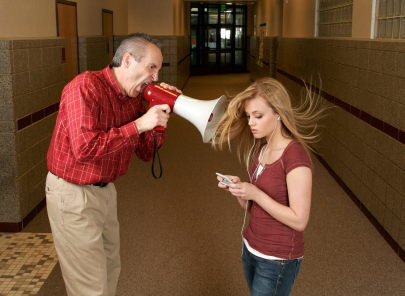
From my observations in schools specifically, I have seen phone files firmly inserted as a divide between teacher & student and even student & student. While there is an appropriate time and place for music streamed through Beats by Dre, the idea of students retreating into themselves will not yield positive results in the long run.
The science behind the addiction to music provides insight into why helping students break away from earbuds will be both imperative to their wellbeing as well as an entirely difficult process.
Consider this generic scenario: A student leaves her house at 7:15am to board a bus that takes her to a place she does not necessarily want to go. Immediately she pops in her earphones and traces a path of social removal into a world that she both understands and enjoys. The music speaks to her and she lives her life accordingly even as she is surrounded by friends, peers, and copious amounts of school work that she may or may not find irrelevant.
Her teacher either allows her to be half-in during instruction (as is evidenced by the one ear-bud placed in her ear) or he has given up trying to get her involved in daily activities.
Knowing that the human brain, the frontal cortex in particular, cannot process more than one stimuli at a time, it is nearly impossible for hum-drum instruction or even interaction with peers to consistently win out over her undying interest in Fallout Boy or Major Lazer.
 |
| http://www.rock.com/p/fall-out-boy-stencil-logo-magnet |
But now that the problem has been laid out, here are a few suggestions for either lessening the desire to sink into the world of earbuds or to temporarily abolish it:
- Understand that retreating into music can be a signal of something good. Music can help inspire and motivate students to greatness. Just as a weightlifter uses tunes to push through a workout, students may also benefit from the extrinsic stimulus music provides.
- Quality student-centered instruction is often the remedy for most anti-cooperative behavior. If status quo content delivery renders the same results time after time, maybe those teachers need to re-evaluate their practices. Interesting content can take away the temptation of a student to wind away the minutes with Metallica.
- Music can help remove distractions. If the student can indeed complete quality work with the aid of music to keep peers' antics at bay, then the ends justify the means.
- Relationships with others trump the need for music-induced dopamine. The chemical dependency on music often fills the gap left by social interaction with others. Dopamine offered by laughing with friends can replace the need to wander through crowds in extrinsic silence.
- Engage students in high-interest peer discussions. Explicitly teaching young people how to properly interact with others, while dissecting relevant content, can invite them away from playlists and into the world of meaningful human interaction.
- Let kids be kids, with parameters. Outright bans of headsets will most likely result in an unwanted battle of wills. If music is their thing, let them go for it, while providing constant situations to practice real communication with peers. If the kids know they will have opportunities to rock out during math, they will not be as likely to obsess over connection to music.
Truly, with the wide variety of personalities and backgrounds amongst the students we see everyday, there are a few commonalities shared by the human race.
1. The need to be entertained (or find intrinsic motivation)
2. The need to be involved and accepted
 |
| http://bodyonept.com/2015/05/whats-your-motivation/ |
If our classrooms provide environments that serve to entertain, at least mildly, in order to activate the students' intrinsic motivation, we have greater odds of helping to alleviate their fixation on earbuds and streaming music.
Not that it is possible to successfully engage every student every hour of every day...but it is a step in the right direction.
Is it possible to engage every learner, every hour of every day? Or is just enough to just keep trying?? #EdChat #EdReform #Edutainment?
— Darin Anderson (@coachdarin22) September 21, 2015
Friday, August 14, 2015
Lessons in Education, Featuring Gary Larson: Part V
By Ed Tech Maniac, Darin Anderson

With his cleverly constructed The Far Side comics, Gary Larson has a knack for bringing out the child in all of us. In this particular strip, Larson shows the fun side of even the starchiest of professions - the lab coat-wearing research scientist (and perhaps his close relative - the plaid-donning school teacher).
 Here, one of the simplest reminders of childhood, the ice cream truck (not to be compared to the liver and onions version) serves to break the monotony and stress of applied research and allows the scientists an opportunity to let loose and leave the microscopes behind. The exuberance in their faces - the waving arms and fist pumps - all signify that the otherwise stuffy and subdued docs are going to pound some Klondike Bars and live life, if even just for a few moments.
As thousands of us educators and students head back to school for another year of rote testing, tedious homework, piles of papers to grade, and staff meeting after boring staff meeting, let us really take this Larson gift to heart.
Find time to have fun with your peers, your family, and especially your students. In the midst of yet another common assessment or what-does-this-have-to-do-with-me PD day, look for ways to liven up your experience. As your students struggle through another rough unit in science, take moments to stop and go outside and smell the roses (literally). Keep your kids off balance with an impromptu accordion polka in the school parking lot (I have personally witnessed just such an occasion).
While the pressures of education are ever-increasing, remember that first and foremost we are in the business of people - and people need laughter and fun and spontaneity.
Here are a few ideas, many with a technological flavor:

With his cleverly constructed The Far Side comics, Gary Larson has a knack for bringing out the child in all of us. In this particular strip, Larson shows the fun side of even the starchiest of professions - the lab coat-wearing research scientist (and perhaps his close relative - the plaid-donning school teacher).

As thousands of us educators and students head back to school for another year of rote testing, tedious homework, piles of papers to grade, and staff meeting after boring staff meeting, let us really take this Larson gift to heart.
Find time to have fun with your peers, your family, and especially your students. In the midst of yet another common assessment or what-does-this-have-to-do-with-me PD day, look for ways to liven up your experience. As your students struggle through another rough unit in science, take moments to stop and go outside and smell the roses (literally). Keep your kids off balance with an impromptu accordion polka in the school parking lot (I have personally witnessed just such an occasion).
While the pressures of education are ever-increasing, remember that first and foremost we are in the business of people - and people need laughter and fun and spontaneity.
Here are a few ideas, many with a technological flavor:
- Send your kids (or fellow PLC members) on a scavenger hunt.
- Try the wide variety of brain breaks available at GoNoodle.
- Incorporate music into transition time or during seatwork. Music works wonders for kids and teachers.
- Turn a writing assignment into a mobile video assignment.
- Organize a class food outing. Say, pizza on the football field. Many restaurants will donate for a worthy cause.
- Supply ice cream sundaes with a different topping for each skill or concept demonstrated.
- Book walks, where you literally take your book for a walk...with the pages open, of course. Or use the Kindle app or free public library e-books.
- Hold goofy hat days, or silly socks, or dress like pirates for no other reason than to laugh.
- Most of all, invite the students to come up with their own ideas. After all, aren't they the reason behind all of this?
Tuesday, August 11, 2015
Technology and Entitlement: A Recipe for Success?
By Ed Tech Maniac, Darin Anderson
Life is not to be graded like a standardized test, as is evidenced by the kinds of opportunities available to some but out of reach for others.
Malcolm Gladwell, in his book Outliers: The Story of Success, puts forth the theory that people do not attain success in spite of their circumstances, but because of them. For every inspiring rags to riches story that we hear, there are thousands more success stories that are nowhere close to folklore.

The fact is, Gladwell claims, talent and ability notwithstanding, most successful people simply took advantage of the fortuitous bounces that came their way, while their less unlucky counterparts were left behind. Superior intelligence, for example, is less a factor in one's ultimate success than is where they were born and what advantages were proffered to them.
The son of a farmer in rural Kansas and the Doctor's son from Los Angeles may well have equal intellect and ability, but the two will have vastly different opportunities that will shape them and help determine where they end up.
Or so the theory goes...
While there is much truth in that line of thinking, there is also a much more level playing field in the world today, as each and every one of us strives for our own brand of success. And it is thanks, in large part, due to technology.
To help put this in perspective, in Outliers Gladwell writes about the characteristics of a typical middle-class upbringing:
"The heavily scheduled middle class child is exposed to constantly shifting set of experiences. She learns teamwork and how to cope in highly structured settings. She is taught how to interact comfortably with adults, and to speak up when she needs to. ...the middle-class children learn a sense of 'entitlement'."Even as Gladwell admits that the word "entitlement" carries with it a negative connotation, in its truest definition it actually makes sense. As humans we are all entitled to certain unalienable rights, among those being the ability to acquire information and to learn,
 The gift of technology has allowed all of us, where able, to reap the full rewards of entitlement. Let me illustrate my idea with this example: I was born and raised in a small farming community in Idaho. While I was no stranger to knowledge - I had access to all the books I would ever want to read - my opportunities were limited compared to those my same age who grew up in more urban areas. For several years, we received our newspaper two days after printing. And since we had only two TV stations via our rooftop antenna, I never knew who won Sunday NFL games until the Tuesday after.
Now, with the marvels of ever-advancing technology, such a scenario is rather unheard of. Since that time in the 1980s we have evolved from catching NFL scores and highlights on cable TV programs, to anytime access via the Internet, to now being able to watch live games on mobile devices from wherever we are.
Simply stated, we are now in a culture where we feel entitled to getting whatever information and content we want at the touch of a screen. We don't even need the proverbial button anymore!
If I want to learn how to fix my wife's kitchen mixer, I look it up on YouTube (true story). Similarly, if a kid wants to play guitar or put her hair up in a crazy new braid, there are unlimited resources online to help her do so. If by chance there is not a YouTube tutorial, there are literally millions of discussion threads out there full of all kinds of advice and suggestions. Honestly, at least as far as popular culture goes, there is not an original question out there. By and large, we do not have to wait for our inquiries to be addressed.
However, it is not all good. There are two sides to this tale of entitlement:
1. Access to knowledge has long been the cure to abolishing ignorance, which has been and still is the fodder for tyranny. Ask Hitler or Stalin if they would have liked the Internet in the hands of their citizens.
2. Immediate access to knowledge creates a generation of lazy, me-first citizenry who will grow accustomed to having their brains filled with little to no effort of their own.
These two different roads can and do run simultaneously. What's more, they often intersect with one another, sometimes several times on any given day.

Technology offers our young people opportunities that we could never have imagined even a decade ago. Here are a few examples of what technology can do for our kids as they practice their cultural entitlement to knowledge:
- Encourage them to serve - Knowledge is useless unless it is put into action to better someone. It is even better if what they learn is used to make the lives of others easier. So many students have received acclaim for doing good works; our kids need to see that they can make a difference - and not in some cliched way - but a real impact on their community and their world.
- Connect with others globally - The world is a smaller place because of technology, but how many of our kids use their knowledge of social media to its fullest potential? More than just talking about sports or cute boy bands, discussions of cultures and traditions and beliefs are just a matter of bringing them up.
- Teach them to create - From what we learn comes products and services that make life better for all of us. With all of the creation technology available at little or no cost, our students can be coding and creating new apps, designing and printing useful 3D models, or building robots that perform otherwise mundane tasks for people. The difference between learning and doing is often just access to some basic creation tools.
- They learn to improve their own station in life - Knowledge is power and now more than ever that power can be used for entrepreneurial endeavors. The path from poverty to comfort can be a short one with today's capacity to produce something and market it for little to no cost. E-commerce is not going away, and will continue to flourish in new and unimaginable ways. Many teenagers are taking advantage of the possibilities entitled to them simply via Wi-Fi access.
- No more blind acceptance - In the past hearing something from a reputable source made it as good as true. Now there are so many more avenues for students to explore answers to their questions beyond a classroom. Not only that, there is typically a massive network of students across the world with similar aspirations. Meeting up with them is, well, something our kids take for granted; it's entitled to them.
All recipes must follow a specific order with predetermined amounts of ingredients. Success with technology and entitlement is no different. As Gladwell puts it, we are, to a large degree, products of our environment. Rather than squandering our fortuitous circumstances, we must take full advantage of what we've been given.
Growing up in a world with so much technological ease is a perfect scenario for success for our students. They just may not know how to put the ingredients together correctly.
Are we helping them?
#Breakfast with #EdTech. Using #technology and our #entitlement culture as a #Recipe4Success pic.twitter.com/6dmKFOTsyx
— Darin Anderson (@coachdarin22) August 11, 2015
Saturday, August 8, 2015
periScopeOut: Showcase Your Students and Your School
By Ed Tech Maniac, Darin Anderson
Pop Quiz:
What do these photos have in common?


A: They all illustrate the lighter side of education
B. They all use education to entertain us
C: They all remind us of our school experiences
D: They all portray a negative image about schools
(Answer at the bottom of this post)
When I was growing up, I had the notable schedule, as did many of us, of watching Saved by the Bell every Saturday morning and then catching The Simpsons on Sunday night. Throw in the Fresh Prince during the week, and I was hooked up with all the teenage humor and drama that I needed.
Without a fully developed frontal lobe, of course I could laugh at the hijinks and timely zingers delivered in each of the episodes and not even bat a questioning eye. I especially chuckled at the good-natured jabs at public and private education. I mean, who doesn't love a joke at the principal's expense? It was funny television, and that was okay with me.
Now that I am older and wiser (the ol' prefrontal cortex is just about there, folks!) I can see the errors of my ways. Sure, there is still plenty of humor to be found in shows like this, but with my ability to "know better," I can see the shows I used to love for what they were.
Think of what we learned about education from each of these sitcoms:
Many parents have a poor taste in their mouths when it comes to their own kids' education in large part due to the many many changes that have taken place in schools over the past couple of decades. Increased Federal Bureaucracy, No Child Left Behind, Common Core State Standards, Performance Based Pay, Instructional Technology, and Flavor-of-the-Month Professional Development, to name just a few.
 Add in occasional physical or sexual assault charges, unfair educational practices, rants on social media, or a major television series, and you have all kinds of negative PR about the otherwise wonderful schools across the world.
All of the noise has caused a small but growing firestorm about American education that seems to portray a system that is broken and with no redeemable qualities. To hear some tell it, the teachers of today are lazy and don't care about their students. They are less apt to teach, and more likely to complain on Facebook about their lousy, worthless students and how underpaid they are. They deliver subpar instruction while planning the next teacher's union protest...or lunchtime potluck.
To be clear, there are many instances of schools, administrators, and teachers being up to no good. As educators we know going in that there is a different expectation on us than on other professionals. Don't believe me? When was the last time you visited with your dentist about bicuspids and the quality of dental floss while chatting in Aisle 5 of the Piggly Wiggly?
If we cannot do much to overcome the national trashtalk about education, how do we go about controlling the message that goes out about OUR OWN schools and OUR OWN kids?
Most schools invite parents and community members to take an active role in their schools, from volunteering in classrooms to viewing performances and presentations. Further, school districts and individual schools have a solid social media presence. With Facebook messages or the occasional Tweets, we can keep stakeholders up on the latest announcements and happenings in our schools.
But how many times do schools combine the concepts of visitors and broadcasting outside the building? Check this out.
Up, Periscope.
Periscope is a relatively new app that lets users broadcast a live video feed from almost any smartphone or tablet, and it happens immediately. Since it is linked to Twitter, Periscope will automatically post a link to your live feed to make it accessible to anyone who follows your account. In an instant - just give your broadcast a name and tap the start button - you are live to the entire world. One the broadcast is ended, the entire video is automatically saved to your Periscope account. And it is all for free!
Here are some practical uses for Periscope:
As for the answer to our questions...
Pop Quiz:
What do these photos have in common?
A: They all illustrate the lighter side of education
B. They all use education to entertain us
C: They all remind us of our school experiences
D: They all portray a negative image about schools
(Answer at the bottom of this post)
When I was growing up, I had the notable schedule, as did many of us, of watching Saved by the Bell every Saturday morning and then catching The Simpsons on Sunday night. Throw in the Fresh Prince during the week, and I was hooked up with all the teenage humor and drama that I needed.
Without a fully developed frontal lobe, of course I could laugh at the hijinks and timely zingers delivered in each of the episodes and not even bat a questioning eye. I especially chuckled at the good-natured jabs at public and private education. I mean, who doesn't love a joke at the principal's expense? It was funny television, and that was okay with me.
Now that I am older and wiser (the ol' prefrontal cortex is just about there, folks!) I can see the errors of my ways. Sure, there is still plenty of humor to be found in shows like this, but with my ability to "know better," I can see the shows I used to love for what they were.
Think of what we learned about education from each of these sitcoms:
- Principals and teachers are fools and should be made fun of whenever possible
- Breaking rules was not only okay, it made one legendary (See: Bart Simpson & Will Smith's School Jacket)
- No teaching ever went on; it was all dating, drama, and detention
- Making fun of teachers and classmates was also an easy way to achieve legendary status (see: Screech, for the end result of that.)
- Bright and hardworking students (Lisa Simpson) were made the brunt of jokes - because who needs smart people, right?
- As for nerds, well, it was always open season on them. Right, Carlton?
- Above all, school was a place to goof off, while actual learning was unheard of
Many parents have a poor taste in their mouths when it comes to their own kids' education in large part due to the many many changes that have taken place in schools over the past couple of decades. Increased Federal Bureaucracy, No Child Left Behind, Common Core State Standards, Performance Based Pay, Instructional Technology, and Flavor-of-the-Month Professional Development, to name just a few.

All of the noise has caused a small but growing firestorm about American education that seems to portray a system that is broken and with no redeemable qualities. To hear some tell it, the teachers of today are lazy and don't care about their students. They are less apt to teach, and more likely to complain on Facebook about their lousy, worthless students and how underpaid they are. They deliver subpar instruction while planning the next teacher's union protest...or lunchtime potluck.
To be clear, there are many instances of schools, administrators, and teachers being up to no good. As educators we know going in that there is a different expectation on us than on other professionals. Don't believe me? When was the last time you visited with your dentist about bicuspids and the quality of dental floss while chatting in Aisle 5 of the Piggly Wiggly?
If we cannot do much to overcome the national trashtalk about education, how do we go about controlling the message that goes out about OUR OWN schools and OUR OWN kids?
Most schools invite parents and community members to take an active role in their schools, from volunteering in classrooms to viewing performances and presentations. Further, school districts and individual schools have a solid social media presence. With Facebook messages or the occasional Tweets, we can keep stakeholders up on the latest announcements and happenings in our schools.
But how many times do schools combine the concepts of visitors and broadcasting outside the building? Check this out.
Up, Periscope.
Periscope is a relatively new app that lets users broadcast a live video feed from almost any smartphone or tablet, and it happens immediately. Since it is linked to Twitter, Periscope will automatically post a link to your live feed to make it accessible to anyone who follows your account. In an instant - just give your broadcast a name and tap the start button - you are live to the entire world. One the broadcast is ended, the entire video is automatically saved to your Periscope account. And it is all for free!
Here are some practical uses for Periscope:
- Classroom lectures and presentations can be viewed at home by students who are ill or just as a refresher from kids who were in attendance.
- Parents who are unable to attend their child's class presentation can still join in on the fun.
- A proactive principal or teacher can broadcast school activities or innovative class projects as they happen.
- Students can Periscope each other completing components of a project. (think: PBL)
- Back to school night, or math night, can go worldwide as a principal scans her building in search of positive comments from staff, parents, and students.
- Extracurricular activities can unite a community when put on Periscope.
- Opening a new or building or wishing to show off major renovations? Periscope it!
- Field trips remain more than just a memory when they are broadcast to the world. During and afterwards, students and parents can watch the feed and relive the experience.
- Seamless integration with Twitter, expands an already powerful educational tool.
As for the answer to our questions...
LIVE on #Periscope: The Answer to Our Question https://t.co/gNFEoNFCsz
— Darin Anderson (@coachdarin22) August 8, 2015
Thursday, August 6, 2015
Lessons in Education Featuring Gary Larson: Part IV
Written by EdTechManiac, Darin Anderson
In the latest installment of our comical series, we will explore the concept of idea exploration in schools. Let's just hope that no one gets hurt in the process. ;-)


Aside from stopping Grog and his buddies before they hurt someone, we should be praising the initiative and ingenuity of the group as it tries something new, or something more revolutionary that has never been done, if that's the case. All of these mini moments - micro-experiences let's call them - add up to create authentic macro-experiences that make a huge difference in the lives of our students.
In the latest installment of our comical series, we will explore the concept of idea exploration in schools. Let's just hope that no one gets hurt in the process. ;-)

Among other things, Gary Larson is noted for using prehistoric figures to represent modern kinds of thinking. In this comic, we see a group of neanderthals exhibiting modern scientific principles (note the clipboard-holding caveman near the bottom) by conducting a controlled experiment.
What we also have before us is a comedic look at the sheer idiocy of tying a living being to the outside of a rock wheel.
Whether or not he has studied science, modern man understands the basic principles of physics, through experience mostly, and knows what is about to happen to the unsuspecting man...and so we laugh. (Granted, it shows how demented we can be as a society, but that is another story for another day.)
Looking at the paragraph above, which is the most important word to you? Science? Physics? Demented?
I contend that the single most important term is "Experience."
Now, look back at Larson's creation and ask yourself this question:
Is it not true that the only reason we find humor in this comic is because these men do not have the background knowledge necessary to see an otherwise obvious tragic ending?
We are laughing at them because they do not know what we know. In that light, maybe it is not as funny anymore.
When put into educational terms, how many of our students walk into class knowing as much as WE know? How many of them have had the same depth of experiences as WE have had? The younger they are the less likely it is that they are aware of much of the content they learn about.
Schools often claim that they allow their students free range of exploration and experimentation - that they are free to make mistakes because that's how we learn. But then they are effectively held hostage by mandated testing that does not honor them for experimenting with the 4 answer choices. No standardized assessment that I know of allows students to make a choice, determine that it was the wrong option, and be able to go back and try again.
Or even worse, school and classroom environments create situations where risk takers and trendsetters are laughed at when they fail. Or ridiculed for trying to be "better" than their peers. Or told that being excellent makes others feel bad. Their experiences are controlled, to a certain extent.
Under similar environments would the airplane exist? Indeed, no one makes fun of the Wright Brothers for crashing plane after plane because society now takes advantage of their ultimate triumph everyday all over the world. We are grateful for their experiences and what their failures amounted to in the long run.

What about the kinds of technology we use on a daily basis? Would we all be pulling out our smartphones and strapping on wearable devices if developers around the world were given one single shot to create the touchscreen interface?
The trouble is that legislation and funding and school accreditation are all tied to some extent or another on static, one-shot assessments.
However, not all aspects of education revolve around standardized test scores. That which we do not control, we cannot change. So what can we do?
With educational technology, and many other teaching tools and strategies, we can create environments that foster creativity and exploration and that encourage experimentation. All of these serve to give our kids experience. Here are just a few ideas:
- Learning Logs or Journals (Written or Audio) - In whatever format they may be, these student-created products provide so much more than just a running commentary of the process of learning. When used to their full potential, logs or journals can become a student's personal portfolio, full of examples of what works and what does not, reflection on successes and failures, and key understandings related to any academic experience. Some of the entries can be teacher recommended, but by and large, log content must be student-generated reflection and analysis. Digital formats, such as a Google Doc, allow for anytime access, which is a stark advantage over paper notebooks. Further, the written word is a vital component of learning, but no one is saying that the logs must be word-processed. Let your students record themselves over a series of PodCasts or audio messages available on most mobile devices and laptops.
- Grading and Assessing Processes not Products - If all a teacher sees is a student's final product, which may or may not be a success, he is missing out on the whole story. Comparatively speaking, if someone only reads the final 15 pages of a novel, she is left with confusion and an uneducated opinion of the story as a whole. With the advantage of the above-mentioned logs or journals, that same teacher can get a snapshot, aside from classroom formative assessment, that helps give her a better understanding of the students' complete stories - she gets the whole picture.
- Legal Hacking - The new definition and function of hacking is nowhere near the same as its predecessor, although many of the same skills are used. Today's hacking (aptly called hackathons) refers to brainstorming sessions put on by businesses across the world. Employees and other interested parties come together to code, with the intent of improving, creating, and/or exploring business software programs and other operations. Some companies sponsor time for employees to develop ideas for and work on new apps. Schools, and a few corporations, have taken the concept a step further and provide structured time for "hackers" to brainstorm solutions to local or regional problems, or to come up with ideas for improving, well, anything.
- Bad Idea Factories and 20% Time Projects - Sometimes the best ideas come from horrible beginnings. The old saying goes that there is no such thing as a stupid question. The same can be said for bad ideas. Even if the result is worthless and/or dangerous, there is something to be learned from the process - if not the product. While I do not condone students burning down random structures to test Freud's Theory of Psychoanalysis (now THAT"S a bad idea), I am a advocate of the process of separating good ideas from not-so-good ideas; the thinking and creativity involved cannot be replicated any better. When classrooms across the country kick off 20% Time Projects, many of them begin with bad idea factories as a way to brainstorm and get ALL ideas out on the table. From those bad ideas grow fruitful endeavors - think manure as food for fruits and vegetables. The 20 Time projects speak for themselves as far as creativity, sustained reflection & analysis, and dealing with setbacks are concerned.
- Teacher Modeling - This is far and away one of the best teaching strategies out there. Especially when it comes to the concept of learning from mistakes, when a teacher is willing to put him or herself out on the line and authentically "screw up" in front of a group of kids, an environment is being established. However, messing up and laughing it off is only step 1 of the process. From there teachers must explicitly model the additional concepts of reflection, revision, and the good ol' fashioned second try. Or third. Or fourth. It is this almost systematic grit and determination that we wish all kids develop and cultivate in school. Any of the above suggestions will work only if students and teachers are fully participating in the entire process of learning, not just checking in at the end of a unit or at test time.
Aside from stopping Grog and his buddies before they hurt someone, we should be praising the initiative and ingenuity of the group as it tries something new, or something more revolutionary that has never been done, if that's the case. All of these mini moments - micro-experiences let's call them - add up to create authentic macro-experiences that make a huge difference in the lives of our students.
Quality daily #microexperiences in school allow our Ss to build #Macroexperiences in the long run. #Neverwasteaday #Italladdsup #edtech
— Darin Anderson (@coachdarin22) August 7, 2015
Tuesday, August 4, 2015
How Technology Can Foster Divergent Thinking in Our Students
By EdTechManiac, Darin Anderson
In his book Outliers: The Story of Success, Malcolm Gladwell lines out the differences between convergent thinking and divergent thinking by discussing two different types of questions.
The first question type, Gladwell explains, is the convergent kind, often used by prestigious universities and high-powered corporations to measure intelligence and aptitude of potential applicants and employees. Convergent assessments, such as the Raven's Test (or Raven's Progressive Matrices), developed by psychologist John C. Raven in 1939, are typically used to determine a person's IQ.
Raven's assessment gives users a series of multiple choice questions in the form of patterns, and they are to identify the shape that will complete the pattern. Simply stated, the convergent mind will be better able to decipher the patterns and ultimately end up with the single correct answer. From the total number of questions answered correctly, the test-taker is given a final IQ score. If it is high enough, Gladwell notes, he or she receives a free pass to Harvard, Cambridge, or another such institution. If it is too low...hello, State U!
Gladwell also touches on a second question type - those of a divergent nature. This style of questioning opens up opportunities for creativity and imagination, as well as analysis and cognition (landmarks of convergent tests). Outliers describes just such a question:
A quick comparison between the two types of questions may lead to some of the following conclusions:
In his book Outliers: The Story of Success, Malcolm Gladwell lines out the differences between convergent thinking and divergent thinking by discussing two different types of questions.
 |
| raventest.net |
Raven's assessment gives users a series of multiple choice questions in the form of patterns, and they are to identify the shape that will complete the pattern. Simply stated, the convergent mind will be better able to decipher the patterns and ultimately end up with the single correct answer. From the total number of questions answered correctly, the test-taker is given a final IQ score. If it is high enough, Gladwell notes, he or she receives a free pass to Harvard, Cambridge, or another such institution. If it is too low...hello, State U!
Gladwell also touches on a second question type - those of a divergent nature. This style of questioning opens up opportunities for creativity and imagination, as well as analysis and cognition (landmarks of convergent tests). Outliers describes just such a question:
"Write down as many different uses that you can think of for the following objects:
1. a brick
2. a blanket"The testing subject is then given a fixed amount of time to provide as many responses as possible. There are no "right" or "wrong" answers...just answers. Thus whatever direction(s) the test-taker chooses to go, the results are divergent.
A quick comparison between the two types of questions may lead to some of the following conclusions:
- Only Smart people do well on convergent tests
- Average and Below Average people do not excel on convergent tests - they're too hard for them
- Smart people can also do well on divergent tests...because they are smart...Duh!
- Average and Below Average people can do well on divergent tests because there are no wrong answers; they are fail-proof
- Convergent tests are a better method of assessing intelligence than are divergent tests
- Analysis and reasoning are more important to intelligence than creativity and imagination
- High School Student named Poole: (Brick) To use in smash-and-grab raids. To help hold a house together. To use in a game of Russian roulette if you want to keep fit at the same time (bricks at ten paces, turn and throw—no evasive action allowed). To hold the eiderdown on a bed tie a brick at each corner. As a breaker of empty Coca-Cola bottles. (Blanket) To use on a bed. As a cover for illicit sex in the woods. As a tent. To make smoke signals with. As a sail for a boat, cart or sled. As a substitute for a towel. As a target for shooting practice for short-sighted people. As a thing to catch people jumping out of burning skyscrapers.*
- High School Student named Florence: (Brick) Building things, throwing. (Blanket) Keeping warm, smothering fire, tying to trees and sleeping in (as a hammock), improvised stretcher.*
*Source: Gladwell, Malcolm. Outliers: The Story of Success. 1st ed. New York: Little, Brown and Company, 2008.
Given the choice to associate with either student, which of you would pick Poole and who would chum around with Florence?
Now, how about a closer look at their respective aptitudes?
Poole is defined in Gladwell's book as a student "in a top British high school," while Florence was described by Hudson himself as "a prodigy, with one of the highest IQs in his school."
Both able and willing, but, as Gladwell poses it, which student is more likely brilliant and creative enough to win a Nobel Prize?
Looking back at some of the most successful people of our time, we see names like Walt Disney, Martha Stewart, Steve Jobs, and Oprah Winfrey. Certainly, these folks, and hundreds of others, have exhibited a certain creativity and innovation along with astute cognitive abilities that helped them on their path to greatness.
But what about this list of similarly successful folks?
 |
| (L-R) Taylor Swift, Rhonda Rousey, Kevin Hart, and Lionel Messi (Highlights here!) |
While this group exhibits notoriety in pop culture arenas, they each certainly display the same kinds of creativity that we look for in sports and entertainment figures. Those qualities and ideas have even crashed their way into the corporate world. Enterprises like Google, Microsoft, and Facebook are famous for offering - even requiring - their employees to spend time being creative. This freedom to explore and create without fear of failure has led to some groundbreaking technology that most of use daily without so much as a cognitive thought.
It is this kind of philosophy that should permeate each and every school system across our country. So much is said in education today about creativity, imagination, and risk taking...but nothing ever really has happened on any kind of large and meaningful scale. There is so much resistance to change.
However, the ball is rolling and it is gathering steam (S.T.E.A.M. - get it?) as is evidenced by the huge movement towards education technology and associated programs such as Ed Camps, Maker Movements, and Hack-a-Thons that pop up all over the country on an almost daily basis.
 And that is the crux of my argument. Technology use - in and out of the classroom - can help foster divergent thinking in a way that was unheard even 5-10 years ago. Divergence has typically been seen as an anti-societal norm, especially by the so-called establishment. Going against normalcy was met with detention, suspension, or expulsion when in fact it could have been an opportunity for exploration and development. (Understand I am not talking about malicious behavior in school, although such is often exhibited as a result of boredom or irrelevancy of content in the classroom.)
Now that divergent ways of teaching, learning, and thinking are becoming more mainstream, educational technology is poised to make an even bigger splash.
Here are a few examples of how technology can help foster divergence in the classroom:

It is this kind of philosophy that should permeate each and every school system across our country. So much is said in education today about creativity, imagination, and risk taking...but nothing ever really has happened on any kind of large and meaningful scale. There is so much resistance to change.
However, the ball is rolling and it is gathering steam (S.T.E.A.M. - get it?) as is evidenced by the huge movement towards education technology and associated programs such as Ed Camps, Maker Movements, and Hack-a-Thons that pop up all over the country on an almost daily basis.
And that is the crux of my argument. Technology use - in and out of the classroom - can help foster divergent thinking in a way that was unheard even 5-10 years ago. Divergence has typically been seen as an anti-societal norm, especially by the so-called establishment. Going against normalcy was met with detention, suspension, or expulsion when in fact it could have been an opportunity for exploration and development. (Understand I am not talking about malicious behavior in school, although such is often exhibited as a result of boredom or irrelevancy of content in the classroom.)Now that divergent ways of teaching, learning, and thinking are becoming more mainstream, educational technology is poised to make an even bigger splash.
Here are a few examples of how technology can help foster divergence in the classroom:
- Collaboration with other like-minded users via social media. No matter how big or small one's location is, a student cannot always rely on having someone nearby who shares the same ideas and interests. With the ease of social media, students of all ages can find and reach out to others with similar goals and aspirations. In the case of October Sky, for example, how much would those boys have benefitted from social media contacts outside of West Virginia?
- Access to various points of view. With careful and calculated consumption, our students can learn as much as they want about nearly any subject and from all angles. A wolf protector in Chicago, for example, may learn how the predator affects the very way of life for a farmer in the Intermountain West. Or an avid hunter might understand how some Native American cultures view certain animals.
- Access to material that was once only available for the social elite. No longer must the teacher or the textbook be the sole sources of information. In fact, we have more access available to us in digital format now than ever before. In Good Will Hunting, there is a famous line that goes as follows: "You dropped 150 grand on a (expletive) education you could have got for $1.50 in late charges at the public library." First uttered in 1997, the words seem to be even more true now, and we don't even have to leave our couches!
- Avoiding functional fixedness with online gaming. Growing up, you perhaps thought that your mother's sauce pan was made for just one thing...a drum, of course! Then one day, you had a crazy idea - what if you could make macaroni and cheese in the inside of your drum?? Viola! Functional fixedness destroyed. Daniel Pink is well known for his book Drive, in which he offers this set of pictures that depict and experiment conducted by psychologist Karl Dunker in 1945. The task was to attach the burning candle to the wall with only the thumbtacks. With some creativity, it becomes possible...as long as the box is seen as more than just a container for holding tacks. This kind of divergent problem solving is on display in a game called Limbo, available here. It's a bit dark, but it does get the job done. As do many, many other games.

The notion of divergent thinking is nothing new. However, encouraging our students (and teachers) to think that way has often been viewed as a bit of rebellion at worst, or non-compliance at best. Changing the perceptions of "it-worked-for-me" parents, community leaders, and legislators has been a struggle as well.
The fact is, while some aspects of traditional education are irreplaceable, so many others are outdated and irrelevant with 21st Century teachers and learners.
In the early 1900's, Robert Frost penned words that turned out to be well ahead of his time:
The fact is, while some aspects of traditional education are irreplaceable, so many others are outdated and irrelevant with 21st Century teachers and learners.
In the early 1900's, Robert Frost penned words that turned out to be well ahead of his time:
"Two roads diverged in a wood, and I—
I took the one less traveled by,
And that has made all the difference."
#EdReform #EdTechChat #EdChat
— Darin Anderson (@coachdarin22) August 4, 2015
What if Frost's teacher had told him there was only one road to take?Monday, August 3, 2015
Lessons in Education, Featuring Gary Larson: Part III
By EdTechManiac, Darin Anderson
Many of Gary Larson's comic strips from The Far Side tell so much of a story without so much as a word of dialogue. With his brilliance - no matter how off-the-wall it might be - Larson can indeed draw a picture that is worth well more than a thousand words.
In Part III of the EdTechManiacs comical Gary Larson series (see Parts I and II here), we will discuss how the "delicious" dish of liver and onions relates to the kinds of products we deliver to our students in the classroom and to teachers in schools across the country.
This Larson offering is both playing off of the innocence of youth and preying upon the insecurities of all of us. Remember, ages ago, when you would clamber outside at the very sound of the ice cream truck rolling down your street? Do you also recall the opposite emotions upon finding out that your mom was making your least favorite meal that night? (Mine was goopy and neon green split pea soup.) This cartoon sums up both the elation of summertime treats and the gloom of unappetizing fare.
 Kindergartners enter their first year of "official school" having gone through six years of questioning and inquiry and curiosity. Many times, they also lack a filter that typically comes with maturity and age. (This is why a 5-year-old can get away with calling a man fat, while a teenager would get scolded for not knowing better.) All of this results in groups of children who know what they want ...and also what they do not want.
 To me, any response to this question begins with some analysis of your constituency - students, parents and/or staff. You may think you know what your kids need, for example, because of mandated testing, curriculum maps and such. But DO you really have a finger on the pulse of your kids? Or your staff?
Many of Gary Larson's comic strips from The Far Side tell so much of a story without so much as a word of dialogue. With his brilliance - no matter how off-the-wall it might be - Larson can indeed draw a picture that is worth well more than a thousand words.
In Part III of the EdTechManiacs comical Gary Larson series (see Parts I and II here), we will discuss how the "delicious" dish of liver and onions relates to the kinds of products we deliver to our students in the classroom and to teachers in schools across the country.
 |
| Compare this comic to a classroom setting from your past. What did you learn? |
Honestly, most of us are fairly competent at sniffing out each kind of opportunity. As the old adage goes, if it looks like liver and smells like liver, it's probably liver, no matter what lengths a person goes to in order to make it seem otherwise. Our students, on one hand, are especially keen at this - and the younger they are the better they are at it.
Our students come into our schools with preconceived ideas about what they want to learn and what they will attempt to avoid at any cost. Granted, so much of their desires center around content that schools cannot offer directly, but the students still show up with that yearning to learn more about them.
Even as traditional school may be a chief contributor to killing that creativity and inquiry, this Larson comic speaks volumes about changing school culture at fundamental and actionary levels.
How can we better gear our kids towards reaching standards outside of their control while also allowing them to achieve their own learning goals? This becomes the $68.6 billion question that educators must try to answer.
Let's begin jumping into the answers to this deep and broad subject by posing a few more questions.
- How many educational opportunities are packaged as something inviting and cutting-edge, but really offer only outdated or irrelevant information and content?
- Or worse, why is something viable and meaningful too often delivered via a vehicle designed for carrying disgusting meats?
- How can we do it all without adding anything more to our already heavy plates?
 To me, any response to this question begins with some analysis of your constituency - students, parents and/or staff. You may think you know what your kids need, for example, because of mandated testing, curriculum maps and such. But DO you really have a finger on the pulse of your kids? Or your staff?
Like the kids in the comic, you might be approaching them with some scrumptious liver...when they are actually looking for a dreamsicle. I mean, who would do that, right?
To a certain extent, our hands are tied when it comes to the WHAT in education. However, we have a multitude of options when it comes to the HOW. With that in mind, we can better serve others if we know more about what they like (ice cream) and what they do not (liver).
To begin, here are a few "Livers" (things that were once cool, but are now like the 8-Track) that might be better left behind:
- Introducing and delivering content via PowerPoint - They are essentially the same as paper, but you can't doodle on them during classes or PD days.
- Sit-and-Get lectures and PD offerings - Today's generation is mobile and agile; sitting is the new smoking
- Pencil and Paper worksheets, graphic organizers, and, well, anything - While I understand that pencils will never become obsolete, ummm, neither will technology.
- One-at-a-time student presentations - Not only do these take up valuable instruction time, they also take up way too much time. Did I mention that they are time-consuming as well as lengthy? Oh, and it's boring, too.
- Teacher-Assigned Products or Projects - Honestly, the world does not need any more landfills full of dioramas and tri-fold posters.
- The Archaic "No Cell Phones" Poster - Nowadays, it's the same as telling folks to leave their textbooks and such at home. The mobile device is a powerful tool that can be used for good AND evil. The choice is up to you.
- Speaking of Textbooks... - With constantly changes research landscapes, textbooks are almost outdated the moment they are published. Up-to-the-minute information is available at the touch of a screen. Why fight a losing battle when learners will head to Google anyway?
Rather than rolling down the street in our Liver-Mobile - even with the catchy trolley-style music - we could approach our Cell Mitosis unit or Standards-Based Grading PD (or whatever) from a different perspective.
Try these on for size:
- YouTube - Your kids use it...so should you. Perfect for flipping or blending instruction and for anytime learning.
- Social Media - Of course, this is a biggie for most of us. So brainstorm ways to get your kids and/or peers discussing and collaborating on Twitter, Facebook, and Instagram.
- 3D Printing - What if your 2D doodles could come to life as tangible 3D objects? This is a current craze that will only gain more ground as the products advance. What was once untouchable technology if now fairly standards in most schools.
- 4D Augmented Reality - Programs like Aurasma, Augment, and DAQRI have taken interacting with content to a whole new level. Once limited to just consumption, AR programs are now beginning to allow kids to create and publish their own 4D designs.
- Green Screen Technology - What used to be sophisticated and expensive is now available on laptops and tablets alike. Going green allows for creativity and expression while also producing quality content that is digitally shareable. Did I mention that it also saves valuable instruction time?
- Making the World a Classoom - Whether it is connecting with someone from abroad on Twitter or sharing resources with a classmate from across town on Google Drive, people are no longer limited to what they can see from their own location.
- Gamification - On the heels of the recent Microsoft purchase of Minecraft, the EdTech world is all the more abuzz about combining what many kids already know - gaming - with what they "need" to know (in an academic sense). With some creative thinking Clash of Clans can indeed become a viable curriculum.
As we look to advance our field and hone our craft, we will be in a constant state of research and reflection. Change is certain. No longer should we disguise liver and onions as quality education. One taste and they'll figure it out.
As #educators do we provide #relevantinstruction for our schools or R we delivering #liverandonions? #EdReform pic.twitter.com/CSsavE6bHa
— Darin Anderson (@coachdarin22) August 3, 2015
Subscribe to:
Posts (Atom)