Showing posts with label Technology Integration. Show all posts

Friday, May 13, 2016

Seeing the Forest AND the Trees: Student Exploration Time


By Darin Anderson

Picture this: You arrive for your first painting lesson from a renowned local artist. Before you lay all the materials you need to begin creating your first masterpiece.

As you settle in with your surroundings, in walks the artist, who begins visiting with each participant about the beauties of art and painting.

You simply cannot wait to get started.

Monsieur Paintbrush walks to the front of the room and begins speaking to the group about the endless possibilities of paints and palettes and prisms of color. He continues into very interesting dialogue about purpose and passion, and you become even more excited to fill your empty canvas with wonder.

However, as the minutes pass by, you notice the instruction, while incredibly valuable and inspiring, has left you no time to do what you came for.

As the artist bids you a find adieu, you leave your still blank canvas and pristinely clean brushes behind, hoping for a chance - next time - to work wonders with them.
_______________________________________________

Would you stand for such circumstances? Regardless of whether or not you paid a fee for the class, I'm certain you would be disappointed with the outcome. Why, you never even got to open up the paints!

Imagine the thousands of students who walk in and out of thousands of classrooms each school day with the same emotions - "Sounds cool, but I never even got a chance to try it out!"

Now, imagine yet another situation - similar and just as frustrating to our students:

Monsieur Paintbrush walks to the front of the room and instructs you to follow his lead in painting a red flower. He takes you step by step through the process, even stopping the class to ensure that each participant neither speeds ahead or lags behind. "We all must build the red flower as I do," he says.

Since you are a decent painter who has done his or her share of flowers, bushes, and trees, you begin to become antsy and annoyed at the teacher for not letting you "do your own thing" and paint what you want. But in the interest of staying with the group you decide to just remain silent and paint your red flower.
_____________________________________________________

While I understand the need for direct instruction and scaffolding in classrooms, I believe that we often go overboard with controlling the scenario in the interest of classroom management and, honestly, making our own lives as teachers easier.

However, many of our students leave classrooms each day without having had the opportunities to explore and design and create and tinker with (insert content/skills here).

Think of the tools we have in our classrooms that are metaphorically represented by the canvas, brushes, and paints in our story:
Computers and laptops
iPads and other tablets
Video cameras
Student Smartphones
3D Printers (perhaps)
CNC Machines (perhaps)

Not to mention these:
Glue
Scissors
Cardboard
Paper
String
Plutonium (according to Dr. Emmett Brown, it should be readily available these days)

But those "standard issue" tools are only the beginning. Think of a computer (or other device) as a box of toys. In and of itself it is a container with little practical use. However, the inside holds the wonders of the world (and I'm not talking about word processing programs).

For example:
+ Google Hangouts or Skype allows staff and students access to content area experts all over the world.
+ 3D programs such as Tinkercad and Thingiverse make design and creation easily accessible for users.
+ Video and audio creation programs allow students to express themselves as never before.
+ 24/7 discussion and collaboration are a snap with Google Drive and a wide variety of social media outlets.

But here I am preaching to the choir. Or am I?

Please take to heart the memes inserted in this post. Ensure that on a daily basis you are having your students explore, create, design, and tinker with content, skills, and - most importantly - their own thoughts and ideas.

Our world - and their - will be the better for it!

Monday, April 18, 2016

Virtual Cultural Exchange: How Your Students Can Go Worldwide

When it came to educational opportunities, it used to be that students were limited to their local - and maybe regional - surroundings, depending on geographic location, socio-economic status, and other such factors.

Growing up in rural Idaho (Mackay, population 541 - Go Miners!!) in the 80s, my exposure to the "outside world" came from television shows and newspaper articles. In fact, so dismal was my exposure that I once had to wait until Tuesday morning to find out who won the Super Bowl the Sunday previous!

Once, on a particular family trip to the busting mecca of population known as Idaho Falls, I was bound and determined to find the home of Mike and Carol and their blended family known as the Brady Bunch. Honestly, I had no idea that Los Angeles, California was an actual place; to me, Idaho Falls was THE only place where such occurrences could possibly take place.

While most of us grew up in more urban neighborhoods and had quite different experiences than I did - eventually I was able to travel to such exotic locals as Orlando, Hartford, Tokyo, and Ontario, Oregon (shoutout to the TVCC Chukars!) - there are still those folks who have never had the opportunity to make their way out of their own city, county, or state.

Where I live and teach currently - Rock Springs, Wyoming - we have many such kids among our student body. Again, while many of our kids have been to places far and wide, we have just as many who see Salt Lake City (a mere 3 hours away) as the furthest they have traveled from home in a short lifetime.

However, with the kinds of technology we have available to us know, there are an endless amount of options we have to help our students explore and learn about places they would otherwise never known to exist.

Here is one example:

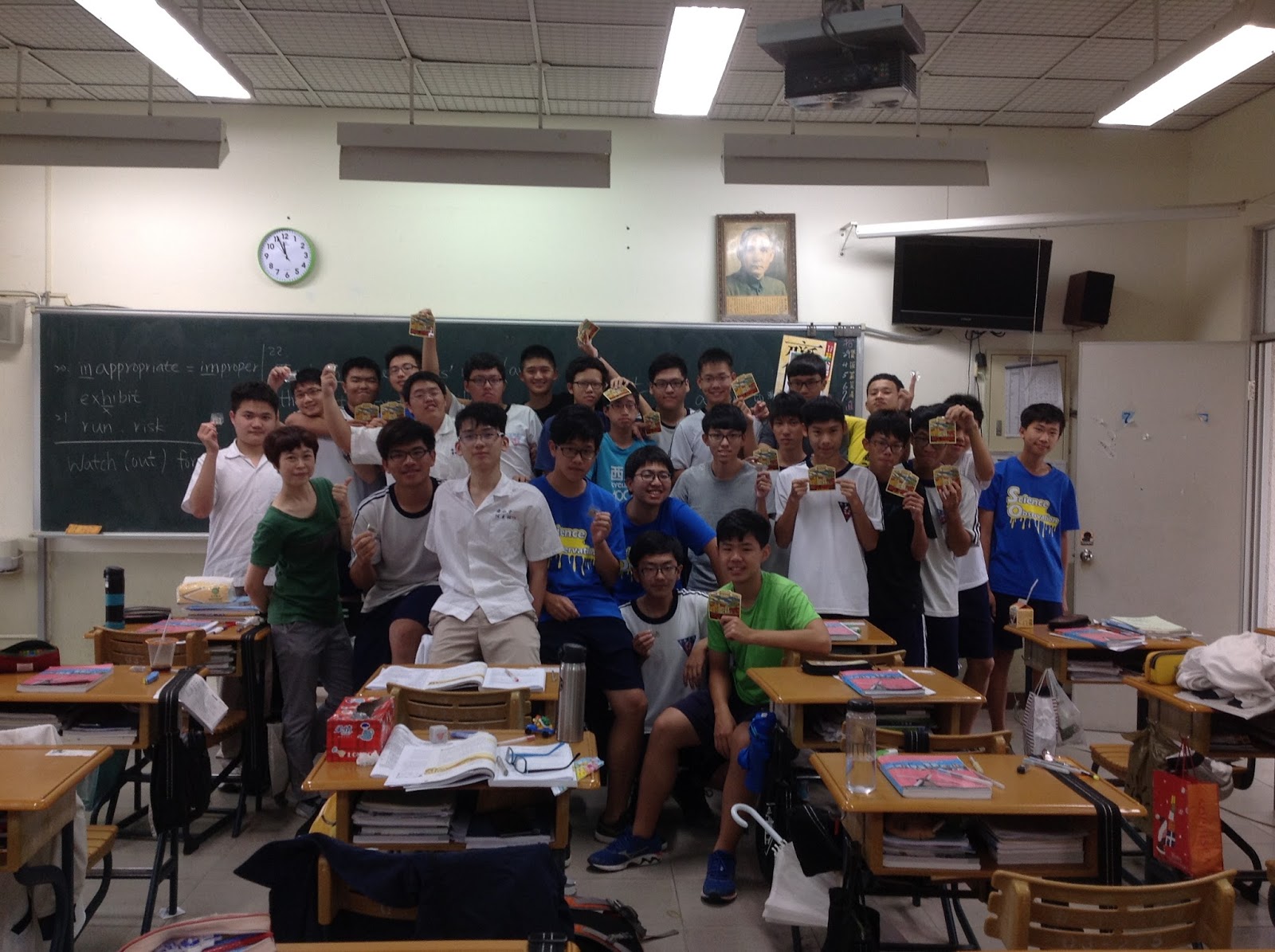
Over the past few months, I have had the pleasure of orchestrating a VCE - Virtual Cultural Exchange - between students of Rock Springs High School and peers in Hong Kong, China, and Taiwan. As part of a World Geography unit of study focused on East Asia, students from RSHS and AIS Hong Kong, AIS Guangzhou (China), and Tainan Second Senior High School (Taiwan).

The initial set-up included lots of emails to international schools, military base schools, and local public and private schools throughout East Asia. After hearing back from a few willing participants, the classroom teacher, Rhonda, and I began setting things up. We conjured up a list of questions and topics for our students to ask and discuss with their overseas peers. We chatted with teachers from all three schools via Google Hangouts and Skype. We grouped kids together and created folders on Google Drive and Wordpress (Thanks, Andrew Chui!) We took a deep breath and hoped our kids would take this exchange seriously!

Finally the day arrived to finally introduce our students to their friends from Asia. Awaiting them in the Google Drive folders were introduction videos full of questions and the local sights of schools and neighborhoods. RSHS students responded in kind with "hello" videos of their own and pictures of our school building, classrooms, and other interesting locations near our school.

Early on, we allowed our students to engage in informal dialogue with their peers overseas. While not all of our kids were as excited as others, the experience turned into quite a wonderful exchange. Before long many of the group began sharing social media information and discussed topics from our upcoming presidential election to the kinds of video games they have in common.

All the while, our students were gathering information to help them complete their World Geo projects and our new friends were practicing English (Taiwan students were all native, non-English speakers) and learning about the rural American West. Both parties shared thoughts, ideas, and opinions about each culture while also posting pictures of local "flavor" and customs.

By no means was this a perfect set-up. Rhonda and I dealt with sporadic attendance, some technology issues, and a bit of laziness, honestly. At the same time, Students from East Asia had to work around English "slang" and technology issues themselves  - Mainland China, for example, does not allow access to Google and Tainan HS blocks Google Hangouts.

It was not an operation in perfection. But it was a highly beneficial VCE that we are looking to replicate and repeat for (hopefully) years to come.

Here are just a few "Ah-Ha's" for us:

1. Overcoming language barriers - There were times when each side had trouble understanding the other. The use of slang, our regional dialect, and unfamiliarity with video-recording processes often left our Asian peers with some confusion. Their video responses were much the same. This taught us all a lesson about...

2. Use of effective communication to convey messages - Many of our kids were asked to speak more slowly and clearly in their video responses. They also had to adjust the wording of their written correspondence in order to better get their messages across. As communication skills are vital to future empolyment in any field, we could not ask for a more authentic experience for our students.

3. Comparing/Contrasting cultures, lifestyles, etc - From a Social Studies standpoint, the information shared was invaluable for our students. Instead of consulting a Website for information, for example, our kids had only to ask authentic questions to their group members in Asia in order to get an authentic response. Which led us to another realization...

4. Asynchronous communication strategies - Our kids quickly found that the time change was going to be a major obstacle to timely correspondence. While a few RSHS students were more than happy to stay up until the wee hours of the morning to live chat with group members, most of them fell into a habit of waiting in anticipation for something new in their Google Drive folders. Aside from time differences, we also had issues with Spring Break holidays in all schools and off-setting schedules (AIS Hong Kong meets on a modified block schedule, for example).

Undaunted, however, we pressed ahead with the VCE, tweaking things here and there, allowing the students to work freely through, it all the while asking for feedback from them.

The results were not optimal, but the process is in place to be something that will be better and better each year.

Here are a few of the results:


Students in Taiwan showing off their Rock Springs Coal stickers!


Friday, September 11, 2015

Class Discussion and Collaboration Made Better with Voxer

By Ed Tech Maniac, Darin Anderson

If you are reading this, it is likely that you are about as tech nerdy as they come. While it is doubtful that a teenager looks at a new app and thinks, How can I use this in school?,  most of us in #EdTech land seek out the educational and instructional potential in each and every new tech device, app, or fad that comes along.

Recently, I was introduced to Voxer by a teacher peer who uses the app to keep tabs on the latest and greatest goings-on with his PLN. As he uses it for such practical advances as sharing lesson ideas and resources, I began to wonder how students could also make use of Voxer's capabilities for more than sharing pics from the football game or messaging answers to tests back and forth. (Not that any group of students would ever do such a thing.)

If you are unfamiliar with Voxer, here is an introduction:


Upon exploring the app, I began to settle in on what is perhaps an obvious conclusion: student collaboration. But however blatantly simple it might seem, the practical uses of Voxer in a classroom setting - the collaboration potential - has my head spinning.

Here are just a few of my ideas:
  • Groups of 3-4 each discuss a different, yet related, topic. Then each member is to add a voice message or two to classmates in different groups. In a matter of a few minutes, there exists a threaded backlog of student thoughts and responses, available for review at any time.
  • Allow pairs to message one another back and forth during review time, brainstorming sessions, or just to discuss a concept. The relative safety of speaking to just one other classmate has the potential to elicit better responses.
  • Anytime Learning is a snap with Voxer as kids, and teachers, can keep conversations going beyond school hours.
  • Voxer has a feature that shows users which group members have heard/seen the message and which have not. This allows the teacher to know who is engaging and who is not, at least at a superficial level.
  • Brainstorming project/product ideas with others is easy with Voxer. Whether on the bus to a football game, sitting in math class, or at home on the couch, if a thought strikes, send a Vox.
  • PLN collaboration on Voxer allows more depth than 140 characters on Twitter. While I am in no way discounting Twitter chats, Voxer lets users send voice, picture, and link "Voxes" as well as unlimited-length text messages.
  • Personal notes and reflections from both students and teachers. Students can reflect on learning as a type of formative assessment, while teachers can also use the app to reflect on lessons that rocked...or those that went awry. 
  • Continuous staff or department chats. Voxer just might be the solution to discussing issues outside of PLCs or department meetings. No more field trip discussion getting in the way of data analysis and planning.
  • The groups are relatively private, unlike a Twitter chat which all of your followers can, well, follow. If you are not invited to a Voxer group or discussion, you will be none the wiser about content. 
There are a few caveats to consider as you look into using Voxer:
  • Voxer works on smartphones. However, If your school does not have Wi-Fi access for student devices, then student mobile data usage may become an issue. Conveniently, it works just fine on a laptop.
  • Not all kids will enjoy hearing the sound of their own voices in the playbacks. It could make for some awkward moments.
  • Listening to responses can be time consuming and some students - and teachers - will prefer not to engage at the depth you'd like.
  • Voxer integrates with Dropbox, even as most folks have become Google Drive users. Not necessarily a huge concern, but something to keep in mind.
Certainly, there are several tools available out there to help spur along student discussion. The basic - but by no means is it basic - version is free, and there are some very nice extras tacked on to the paid edition, which is a paltry $3.99 a month.

Feel free to reach out to me on Voxer to discuss this or any other edtech topic. My handle is darinanderson :-)

Tuesday, August 11, 2015

EdTechManiacs YouTube PodCast

Check out the weekly Tech Talk Tuesday Podcast Below.
We tackle the ideas of Bring Your Own Devices and Periscope in the classroom.
Click Subscribe to be notified of upcoming podcasts.


Technology and Entitlement: A Recipe for Success?

By Ed Tech Maniac, Darin Anderson
Life is not to be graded like a standardized test, as is evidenced by the kinds of opportunities available to some but out of reach for others.
Malcolm Gladwell, in his book Outliers: The Story of Success, puts forth the theory that people do not attain success in spite of their circumstances, but because of them. For every inspiring rags to riches story that we hear, there are thousands more success stories that are nowhere close to folklore.


The fact is, Gladwell claims, talent and ability notwithstanding, most successful people simply took advantage of the fortuitous bounces that came their way, while their less unlucky counterparts were left behind. Superior intelligence, for example, is less a factor in one's ultimate success than is where they were born and what advantages were proffered to them.

The son of a farmer in rural Kansas and the Doctor's son from Los Angeles may well have equal intellect and ability, but the two will have vastly different opportunities that will shape them and help determine where they end up.

Or so the theory goes...

While there is much truth in that line of thinking, there is also a much more level playing field in the world today, as each and every one of us strives for our own brand of success. And it is thanks, in large part, due to technology.

To help put this in perspective, in Outliers Gladwell writes about the characteristics of a typical middle-class upbringing:
"The heavily scheduled middle class child is exposed to constantly shifting set of experiences. She learns teamwork and how to cope in highly structured settings. She is taught how to interact comfortably with adults, and to speak up when she needs to. ...the middle-class children learn a sense of 'entitlement'."
Even as Gladwell admits that the word "entitlement" carries with it a negative connotation, in its truest definition it actually makes sense. As humans we are all entitled to certain unalienable rights, among those being the ability to acquire information and to learn,

The gift of technology has allowed all of us, where able, to reap the full rewards of entitlement. Let me illustrate my idea with this example: I was born and raised in a small farming community in Idaho. While I was no stranger to knowledge - I had access to all the books I would ever want to read - my opportunities were limited compared to those my same age who grew up in more urban areas. For several years, we received our newspaper two days after printing. And since we had only two TV stations via our rooftop antenna, I never knew who won Sunday NFL games until the Tuesday after.

Now, with the marvels of ever-advancing technology, such a scenario is rather unheard of. Since that time in the 1980s we have evolved from catching NFL scores and highlights on cable TV programs, to anytime access via the Internet, to now being able to watch live games on mobile devices from wherever we are.

Simply stated, we are now in a culture where we feel entitled to getting whatever information and content we want at the touch of a screen. We don't even need the proverbial button anymore!

If I want to learn how to fix my wife's kitchen mixer, I look it up on YouTube (true story). Similarly, if a kid wants to play guitar or put her hair up in a crazy new braid, there are unlimited resources online to help her do so. If by chance there is not a YouTube tutorial, there are literally millions of discussion threads out there full of all kinds of advice and suggestions. Honestly, at least as far as popular culture goes, there is not an original question out there. By and large, we do not have to wait for our inquiries to be addressed.

However, it is not all good. There are two sides to this tale of entitlement:

1. Access to knowledge has long been the cure to abolishing ignorance, which has been and still is the fodder for tyranny. Ask Hitler or Stalin if they would have liked the Internet in the hands of their citizens.

2. Immediate access to knowledge creates a generation of lazy, me-first citizenry who will grow accustomed to having their brains filled with little to no effort of their own.

These two different roads can and do run simultaneously. What's more, they often intersect with one another, sometimes several times on any given day.

This is where we can make significant and meaningful differences as teachers of our emerging and curious students. We can show them how to navigate the two diverging and converging roads to best make use of the talents and abilities they have. We can help inspire them to pursue their greatness while also teaching them to temper their desires and take purposeful baby steps.

Technology offers our young people opportunities that we could never have imagined even a decade ago. Here are a few examples of what technology can do for our kids as they practice their cultural entitlement to knowledge:
  • Encourage them to serve - Knowledge is useless unless it is put into action to better someone. It is even better if what they learn is used to make the lives of others easier. So many students have received acclaim for doing good works; our kids need to see that they can make a difference - and not in some cliched way - but a real impact on their community and their world.
  • Connect with others globally - The world is a smaller place because of technology, but how many of our kids use their knowledge of social media to its fullest potential? More than just talking about sports or cute boy bands, discussions of cultures and traditions and beliefs are just a matter of bringing them up.
  • Teach them to create - From what we learn comes products and services that make life better for all of us. With all of the creation technology available at little or no cost, our students can be coding and creating new apps, designing and printing useful 3D models, or building robots that perform otherwise mundane tasks for people. The difference between learning and doing is often just access to some basic creation tools.
  • They learn to improve their own station in life - Knowledge is power and now more than ever that power can be used for entrepreneurial endeavors. The path from poverty to comfort can be a short one with today's capacity to produce something and market it for little to no cost. E-commerce is not going away, and will continue to flourish in new and unimaginable ways. Many teenagers are taking advantage of the possibilities entitled to them simply via Wi-Fi access.
  • No more blind acceptance - In the past hearing something from a reputable source made it as good as true. Now there are so many more avenues for students to explore answers to their questions beyond a classroom. Not only that, there is typically a massive network of students across the world with similar aspirations. Meeting up with them is, well, something our kids take for granted; it's entitled to them.
All recipes must follow a specific order with predetermined amounts of ingredients. Success with technology and entitlement is no different. As Gladwell puts it, we are, to a large degree, products of our environment. Rather than squandering our fortuitous circumstances, we must take full advantage of what we've been given.

Growing up in a world with so much technological ease is a perfect scenario for success for our students. They just may not know how to put the ingredients together correctly.

Are we helping them?

Saturday, August 8, 2015

periScopeOut: Showcase Your Students and Your School

By Ed Tech Maniac, Darin Anderson

Pop Quiz:

What do these photos have in common?
    

A: They all illustrate the lighter side of education
B. They all use education to entertain us
C: They all remind us of our school experiences
D: They all portray a negative image about schools

(Answer at the bottom of this post)

When I was growing up, I had the notable schedule, as did many of us, of watching Saved by the Bell every Saturday morning and then catching The Simpsons on Sunday night. Throw in the Fresh Prince during the week, and I was hooked up with all the teenage humor and drama that I needed.

Without a fully developed frontal lobe, of course I could laugh at the hijinks and timely zingers delivered in each of the episodes and not even bat a questioning eye. I especially chuckled at the good-natured jabs at public and private education. I mean, who doesn't love a joke at the principal's expense? It was funny television, and that was okay with me.

Now that I am older and wiser (the ol' prefrontal cortex is just about there, folks!) I can see the errors of my ways. Sure, there is still plenty of humor to be found in shows like this, but with my ability to "know better," I can see the shows I used to love for what they were.

Think of what we learned about education from each of these sitcoms:
  • Principals and teachers are fools and should be made fun of whenever possible
  • Breaking rules was not only okay, it made one legendary (See: Bart Simpson & Will Smith's School Jacket)
  • No teaching ever went on; it was all dating, drama, and detention
  • Making fun of teachers and classmates was also an easy way to achieve legendary status (see: Screech, for the end result of that.)
  • Bright and hardworking students (Lisa Simpson) were made the brunt of jokes - because who needs smart people, right?
  • As for nerds, well, it was always open season on them. Right, Carlton?
  • Above all, school was a place to goof off, while actual learning was unheard of 
The ultimate result, perhaps, was a generation of students who hated going to school because it did not fulfill their Saved by the Bell fantasies. Now these same folks are sending their own children to school decades later. (Yes, it HAS been that long.)

Many parents have a poor taste in their mouths when it comes to their own kids' education in large part due to the many many changes that have taken place in schools over the past couple of decades. Increased Federal Bureaucracy, No Child Left Behind, Common Core State Standards, Performance Based Pay, Instructional Technology, and Flavor-of-the-Month Professional Development, to name just a few.

Add in occasional physical or sexual assault charges, unfair educational practices, rants on social media, or a major television series, and you have all kinds of negative PR about the otherwise wonderful schools across the world.

All of the noise has caused a small but growing firestorm about American education that seems to portray a system that is broken and with no redeemable qualities. To hear some tell it, the teachers of today are lazy and don't care about their students. They are less apt to teach, and more likely to complain on Facebook about their lousy, worthless students and how underpaid they are. They deliver subpar instruction while planning the next teacher's union protest...or lunchtime potluck.

To be clear, there are many instances of schools, administrators, and teachers being up to no good. As educators we know going in that there is a different expectation on us than on other professionals. Don't believe me? When was the last time you visited with your dentist about bicuspids and the quality of dental floss while chatting in Aisle 5 of the Piggly Wiggly?

If we cannot do much to overcome the national trashtalk about education, how do we go about controlling the message that goes out about OUR OWN schools and OUR OWN kids?

Most schools invite parents and community members to take an active role in their schools, from volunteering in classrooms to viewing performances and presentations. Further, school districts and individual schools have a solid social media presence. With Facebook messages or the occasional Tweets, we can keep stakeholders up on the latest announcements and happenings in our schools.

But how many times do schools combine the concepts of visitors and broadcasting outside the building? Check this out.

Up, Periscope.

Periscope is a relatively new app that lets users broadcast a live video feed from almost any smartphone or tablet, and it happens immediately. Since it is linked to Twitter, Periscope will automatically post a link to your live feed to make it accessible to anyone who follows your account. In an instant - just give your broadcast a name and tap the start button - you are live to the entire world. One the broadcast is ended, the entire video is automatically saved to your Periscope account. And it is all for free!

Here are some practical uses for Periscope:
  • Classroom lectures and presentations can be viewed at home by students who are ill or just as a refresher from kids who were in attendance.
  • Parents who are unable to attend their child's class presentation can still join in on the fun.
  • A proactive principal or teacher can broadcast school activities or innovative class projects as they happen.
  • Students can Periscope each other completing components of a project. (think: PBL)
  • Back to school night, or math night, can go worldwide as a principal scans her building in search of positive comments from staff, parents, and students.
  • Extracurricular activities can unite a community when put on Periscope.
  • Opening a new or building or wishing to show off major renovations? Periscope it!
  • Field trips remain more than just a memory when they are broadcast to the world. During and afterwards, students and parents can watch the feed and relive the experience.
  • Seamless integration with Twitter, expands an already powerful educational tool.
These and many other uses combine to make Periscope a viable resource to control your school's message. Sure, core groups of parents know the goods and the bads of your school district, but with Periscope, you can stay on top of the best parts of what you do for your kids.

As for the answer to our questions...

Monday, August 3, 2015

Lessons in Education, Featuring Gary Larson: Part III

By EdTechManiac, Darin Anderson

Many of Gary Larson's comic strips from The Far Side tell so much of a story without so much as a word of dialogue. With his brilliance - no matter how off-the-wall it might be - Larson can indeed draw a picture that is worth well more than a thousand words.

In Part III of the EdTechManiacs comical Gary Larson series (see Parts I and II here), we will discuss how the "delicious" dish of liver and onions relates to the kinds of products we deliver to our students in the classroom and to teachers in schools across the country.
Compare this comic to a classroom
setting from your past. What did you learn?
This Larson offering is both playing off of the innocence of youth and preying upon the insecurities of all of us. Remember, ages ago, when you would clamber outside at the very sound of the ice cream truck rolling down your street? Do you also recall the opposite emotions upon finding out that your mom was making your least favorite meal that night? (Mine was goopy and neon green split pea soup.) This cartoon sums up both the elation of summertime treats and the gloom of unappetizing fare.

Honestly, most of us are fairly competent at sniffing out each kind of opportunity. As the old adage goes, if it looks like liver and smells like liver, it's probably liver, no matter what lengths a person goes to in order to make it seem otherwise. Our students, on one hand, are especially keen at this - and the younger they are the better they are at it.

Kindergartners enter their first year of "official school" having gone through six years of questioning and inquiry and curiosity. Many times, they also lack a filter that typically comes with maturity and age. (This is why a 5-year-old can get away with calling a man fat, while a teenager would get scolded for not knowing better.) All of this results in groups of children who know what they want ...and also what they do not want.

Our students come into our schools with preconceived ideas about what they want to learn and what they will attempt to avoid at any cost. Granted, so much of their desires center around content that schools cannot offer directly, but the students still show up with that yearning to learn more about them.

Even as traditional school may be a chief contributor to killing that creativity and inquiry, this Larson comic speaks volumes about changing school culture at fundamental and actionary levels.

How can we better gear our kids towards reaching standards outside of their control while also allowing them to achieve their own learning goals? This becomes the $68.6 billion question that educators must try to answer.

Let's begin jumping into the answers to this deep and broad subject by posing a few more questions.
  • How many educational opportunities are packaged as something inviting and cutting-edge, but really offer only outdated or irrelevant information and content?
  • Or worse, why is something viable and meaningful too often delivered via a vehicle designed for carrying disgusting meats?
  • How can we do it all without adding anything more to our already heavy plates?
To me, any response to this question begins with some analysis of your constituency - students, parents and/or staff. You may think you know what your kids need, for example, because of mandated testing, curriculum maps and such. But DO you really have a finger on the pulse of your kids? Or your staff?

Like the kids in the comic, you might be approaching them with some scrumptious liver...when they are actually looking for a dreamsicle. I mean, who would do that, right?

To a certain extent, our hands are tied when it comes to the WHAT in education. However, we have a multitude of options when it comes to the HOW. With that in mind, we can better serve others if we know more about what they like (ice cream) and what they do not (liver).

To begin, here are a few "Livers" (things that were once cool, but are now like the 8-Track) that might be better left behind:
  • Introducing and delivering content via PowerPoint - They are essentially the same as paper, but you can't doodle on them during classes or PD days.
  • Sit-and-Get lectures and PD offerings - Today's generation is mobile and agile; sitting is the new smoking
  • Pencil and Paper worksheets, graphic organizers, and, well, anything - While I understand that pencils will never become obsolete, ummm, neither will technology.
  • One-at-a-time student presentations - Not only do these take up valuable instruction time, they also take up way too much time. Did I mention that they are time-consuming as well as lengthy? Oh, and it's boring, too. 
  • Teacher-Assigned Products or Projects - Honestly, the world does not need any more landfills full of dioramas and tri-fold posters.
  • The Archaic "No Cell Phones" Poster - Nowadays, it's the same as telling folks to leave their textbooks and such at home. The mobile device is a powerful tool that can be used for good AND evil. The choice is up to you.
  • Speaking of Textbooks... - With constantly changes research landscapes, textbooks are almost outdated the moment they are published. Up-to-the-minute information is available at the touch of a screen. Why fight a losing battle when learners will head to Google anyway?
Rather than rolling down the street in our Liver-Mobile - even with the catchy trolley-style music - we could approach our Cell Mitosis unit or Standards-Based Grading PD (or whatever) from a different perspective.

Try these on for size:
  • YouTube - Your kids use it...so should you. Perfect for flipping or blending instruction and for anytime learning.
  • Social Media - Of course, this is a biggie for most of us. So brainstorm ways to get your kids and/or peers discussing and collaborating on Twitter, Facebook, and Instagram.
  • 3D Printing - What if your 2D doodles could come to life as tangible 3D objects? This is a current craze that will only gain more ground as the products advance. What was once untouchable technology if now fairly standards in most schools.
  • 4D Augmented Reality - Programs like Aurasma, Augment, and DAQRI have taken interacting with content to a whole new level. Once limited to just consumption, AR programs are now beginning to allow kids to create and publish their own 4D designs.
  • Green Screen Technology - What used to be sophisticated and expensive is now available on laptops and tablets alike. Going green allows for creativity and expression while also producing quality content that is digitally shareable. Did I mention that it also saves valuable instruction time?
  • Making the World a Classoom - Whether it is connecting with someone from abroad on Twitter or sharing resources with a classmate from across town on Google Drive, people are no longer limited to what they can see from their own location.
  • Gamification - On the heels of the recent Microsoft purchase of Minecraft, the EdTech world is all the more abuzz about combining what many kids already know - gaming - with what they "need" to know (in an academic sense). With some creative thinking Clash of Clans can indeed become a viable curriculum.
As we look to advance our field and hone our craft, we will be in a constant state of research and reflection. Change is certain. No longer should we disguise liver and onions as quality education. One taste and they'll figure it out. 

Friday, July 31, 2015

Lessons in Education, Featuring Gary Larson: Part II

By EdTechManiac, Darin Anderson

In Part II of our comical series on education reform, we examine two different ideas of education in need of some reform. Oh, and ducks...there will be lots of ducks.


Like most of Gary Larson's The Far Side comics, this particular frame offers both a superficial humor as well as a deeper, more philosophical meaning. In this post, I will offer my thoughts on both levels of understanding as they relate to education reform - or altering behavior in any aspect of our lives.

The initial humor is found is the obvious fact that ducks fly, but for some reason or another, this particular brace (look it up) has not yet lifted its wings to the air, so to speak.


Here, Bugs Bunny offers up a cruel bit of irony, at least where Daffy Duck is concerned. In order to save himself from disaster, all the duck has to do is flap his wings, or take advantage of his natural abilities. But he doesn't.

So too, we laugh at the blatant irony of the lead duck looking up at his peers with the sudden epiphany that they too could fly. In educational terms, it is similar to a student (or teacher) who observes his own peers completing any certain action and then thinks, I can do that too. Before long they are simply soaring.

Sometimes all it takes to leverage change is for an interested party - often it is an impressionable child or teenager, but it can be an adult as well - to closely observe the behavior of others and then mimic it. While it is not always that simple in actuality, many behaviors (movements, actions, procedures) can be reproduced on the basis of mental images  - let's call them mind-made movies - alone.

In his book entitled The Inner Game of Tennis, tennis pro Timothy Gallwey speaks of the battle between Self 1, our mind and ego, and Self 2, the part inside of us all that knows what to do if not interrupted by the conscious brain.

Gallwey explains his theory in the context of a tennis lesson he once gave: 
"My next lesson that day was with a beginner named Paul who had never held a racket. I was determined to show him how to play using as few instructions as possible; I'd try to keep his mind uncluttered and see if it made a difference. So I started by telling Paul I was trying something new. I was going to skip entirely my usual explanations to beginning players about the proper grip, stroke and footwork for the basic forehand.
"Instead, I was going to hit ten forehands myself, and I wanted him to watch carefully, not thinking about what I was doing, but simply trying to grasp a visual image of the forehand. He was to repeat the image in his mind several times and then just let his body imitate. After I had hit ten forehands, Paul imagined himself doing the same. Then, as I put the racket into his hand, sliding it into the correct grip, he said to me, "I noticed that the first thing you did was to move your feet." I replied with a noncommittal grunt and asked him to let his body imitate the forehand as well as it could.
"He dropped the ball, took a perfect backswing, swung forward, racket level, and with natural fluidity ended the swing at shoulder height, perfect for his first attempt! But wait, his feet; they hadn't moved an inch from the perfect ready position he had assumed before taking his racket back. They were nailed to the court. I pointed to them, and Paul said, "Oh yeah, I forgot about them!" The one element of the stroke Paul had tried to remember was the one thing he didn't do! Everything else had been absorbed and reproduced without a word being uttered or an instruction being given!"
Most of us self-identify as being visual learners, and this anecdote fully supports that idea. Our students and teaching peers can and do learn so much by closely watching those around them. I imagine that these ducks will be joining their brethren in the sky in no time...as long as no one intercedes and tells them they cannot or should not be doing so. Or worse yet, over-instructs to the point of confusion and discontent between Self 1 and Self 2.

Gallwey put it this way:
"...it is the constant "thinking" activity of Self 1, the ego-mind, which causes interference with the natural doing processes of Self 2. Harmony between the two selves exists when the mind itself is quiet. Only when the mind is still is one's peak performance reached."
While I do not know if anyone told these ducks to walk south instead of fly, it appears that their minds were indeed getting in the way. The old adage, "Spread your wings and fly," is more truth than fiction, at least in a philosophical sense.

How many children enter Kindergarten having been told over and over to not do this or to stop doing that? And once they gain entrance to the school walls do they not still hear the same tone on a daily basis?

Ask a duck. He knows the answer.
If a child wants to experiment with something new, whether it is a new piece of technology or simply a new way of completing a task, is she honestly given the freedom to do so? Educators preach ingenuity and creativity, but how many of us are actually willing to not just lighten up on the reigns, but to take off the halter all together?

Furthermore, how willing are we as educators to model the same kind of behavior by integrating something new into our respective classrooms? Technology. Behavior Management. Student Engagement.

If you think of the flying V formation as a peer you respect and admire - and yourself as a ground-bound duck - does it seem silly to you to NOT try and reach for higher climes? Of course we would make an attempt.

The capacity to excel exists in all of us  - even as most of us will never become as talented as Serena Williams or Roger Federer are at tennis. We do not all have to be given teacher-of-the-year awards to be considered great. But like hitting 9 out of 10 balls in the court is amazing, so to is believing in the children we teach.

10 YouTubing Uses that Align with Common Core Part 1: Speaking and Listening

By EdTechManiac, Blair Einfeldt
*update* For anyone interested, our family YouTube Channel can be found here.

For the first time in quite a while, I have had an abundance of time to spend with my children at home. Chalk that up for my first true teacher summer or living substantially closer to the high school where I teach. Regardless, upon spending this time with my kids I have learned one very important thing:

MY KIDS LOVE YOUTUBE!

Like Lays potato chips, it's impossible
They watch YouTube non stop. They watch gaming videos, they watch cat videos, they even watch videos of people watching videos. You read that correct. I observed my children watching a man who was making a video of himself watching a TV show. And they aren't alone. Sixty thousand other people have watched that same person watching that same video.


Image result for steven universe in education
I pulled out my phone for quick research (there is extreme value to this which I will discuss later) to see how much this man, who watched a TV show, mad for watching said TV show. It was a bit vague but I came to a general consensus that through ad placement, YouTube pays out around about $1.50 per thousand views. So looking at that, I realized that this man made about $90 to sit and watch a 20 minute video of Steven Universe. While that is not a ton of money, if I made $90 for every Steven Universe episode I watched...OH GEEZ!

Anyway, in an offhanded comment I mentioned to my children that they could do something like that and probably even better. I did not realize that I had opened up Pandora's Box. I could not unsay that statement. My children went crazy, jumping around at the possibilities of being YouTube famous. So I, being that Arms-Race-Parent, followed by upping the ante with "Of course, let's do this, and we are going to be the best YouTubers EVAH!" I tend to fall into the world of Hyperbole. 

We soon found ourselves purchasing microphone headsets, video cards, digital film editing programs. I'm a bit ashamed at the amount of time and money that followed that first statement, however there have been some awesome things that come about and while I am an educator, I gave reflection to how YouTube and our current foray into viral video distribution has many parallels and uses in the world of education and especially Common Core. And yes...you should have a class YouTube Channel.

Many of you know this, but Core Standards build upon each other. With that said, I intend to focus on the 11th/12th grade standards as our end goal. If you would like to downgrade the standard to fit your particular grade level, have at it.

Let's Start with Speaking and Listening:

Standard:
Initiate and participate effectively in a range of collaborative discussions (one-on-one, in groups, and teacher-led) with diverse partners on grades 11-12 topics, texts, and issues, building on others' ideas and expressing their own clearly and persuasively.

The traditional way of hitting this standard is a typical class discussion. However, the standard talks about having the students come prepared to the discussion. Class discussions do not generally create that need of preparation as it should.

Try this:

Google has an app called Hangouts. It is essentially Skype for Google. Google, which owns,YouTube, automatically saves a Google Hangout sessions as a video on the YouTube accounts of the people within the Hangout. Put your students in small groups, give them a topic to discuss, but make the discussion a Google Hangout. Give them a 10 minute limit. Spend some time prior and have the students create an outline or even rudimentary script for their hangout.

Being that it will be posted on YouTube, watch the level of quality drastically increase as they are held accountable to the internet (trolls and non-trolls alike).

My children are a perfect example of this. They have created their own standard of creation based on the videos they watch. We have had to create intros, channel art, written scripts, added effects and editing because they were afraid to put poor quality out in the event that the YouTubers that they admire were to watch. They are 5, 7 and 9 years old. Imagine how a 11th grader would improve their quality with that type of internet positive peer pressure.

Standards 2 and 3:
(2) Integrate multiple sources of information presented in diverse formats and media (e.g., visually, quantitatively, orally) in order to make informed decisions and solve problems, evaluating the credibility and accuracy of each source and noting any discrepancies among the data.

(3) Present information, findings, and supporting evidence, conveying a clear and distinct perspective, such that listeners can follow the line of reasoning, alternative or opposing perspectives are addressed, and the organization, development, substance, and style are appropriate to purpose, audience, and a range of formal and informal tasks.

The Film Theorists
Many of the YouTube videos my pre-double digit aged children watch are Theory Channels. The Gamer Theorists, Cartoon Theory, Film Theorists, Cartoon Conspiracy channels, to name a few, put different ideas and hypotheses in place about relevant (to them) topics. Today, my children are being tasked to take a particular theory and evaluate it for accuracy. This is forcing self driven inquiry and research and will culminate in a 7 year old response video disputing or supporting the thesis of someone else. Again, my 7 and 9 year olds are doing this.

Have your students create a response video to another popular video and provide links to their sources in the description. Or provide your students a debated topic like the validity of the moon landing and have them create a YouTube video breaking down their opinion with sources.

On presentation days, rather than your typical stand-in-front-of-the-class presentations, provide your students links or even QR codes to scan with their iPods or personal devices to watch the videos of their choice. Have your students comment on the video for feedback.

Using YouTube in this way will provide the following things for your classroom:

1. Real-world audience

2. Real-world accountability

3. Engagement

4. Transparency

5. Evidence of Use and Implementation of Standards

6. Evidence of Integration of Technology

7. Self Driven Activity

8. Peer review

9. Possibility of Immediate Feedback

10. Increased Level of Ease in Assessment